A galvanized greenhouse structure supplier should provide more than steel pipes, arches and columns.
For commercial greenhouse projects, EPC teams and greenhouse integrators also need to confirm steel grade, tube dimensions, zinc coating specification, wind and snow design assumptions, connection compatibility, fabrication quality, bill of materials and export documentation.
These factors work together.
A higher zinc coating mass cannot compensate for an undersized structural member. A stronger steel tube cannot solve a poorly defined wind-load basis. A complete frame package can still create installation problems when connectors, punched holes, packing identification or drawings do not match.
For this reason, selecting a galvanized greenhouse structure supplier should be treated as a project engineering and execution decision—not only as a steel price comparison.
Quick Answer: What Should Buyers Check?
A qualified galvanized greenhouse structure supplier should be able to confirm:
- structural steel grade and member dimensions;
- tube shape, wall thickness and manufacturing tolerance;
- zinc coating designation and applicable material standard;
- whether the material is continuously galvanized or galvanized after fabrication;
- wind-load, snow-load and structural design assumptions;
- roof shape, span, bay spacing and bracing arrangement;
- weld seam, cut-edge, punched-hole and connection-zone protection;
- compatibility with film, polycarbonate or other covering systems;
- BOM, drawings, packing list and installation information;
- the responsibility boundary between the structure supplier and local EPC or integrator.
The correct solution is not automatically the heaviest tube or the highest zinc coating number. It is the structure specification that matches the project environment, load basis, covering system, expected service life and execution plan.
What Is a Galvanized Greenhouse Structure Supplier?
A galvanized greenhouse structure supplier provides the steel framework and related structural components used to form a commercial greenhouse.
Depending on the greenhouse type, the structural package may include:
- columns;
- arches or rafters;
- purlins;
- gutters;
- longitudinal members;
- cross bracing;
- end-wall framing;
- base plates or ground connections;
- clamps and brackets;
- bolts and fasteners;
- covering-support profiles;
- project-specific connection components.
A commercial supplier should also define the material and coating specifications for these components and provide sufficient documentation for procurement, transport and installation.
This is different from selling a small greenhouse kit.
An EPC-led or integrator-led project requires traceability between the project conditions, structural assumptions, material specification, component identification and delivered package.
That is why the supplier evaluation should begin with the project design basis—not with a generic claim such as “heavy galvanized greenhouse.”
Why Galvanized Steel Is Widely Used in Commercial Greenhouse Structures
Commercial greenhouse structures are commonly exposed to both external weather and an aggressive internal microclimate.
Typical exposure conditions include:
- rain and external humidity;
- condensation beneath the covering;
- repeated wet-and-dry cycles;
- irrigation moisture;
- water accumulation around gutter lines;
- fertilizer or chemical residues;
- coastal salt exposure;
- limited maintenance access after the greenhouse becomes operational.
Zinc protects steel through both barrier protection and sacrificial action. If a localized area of the coating is damaged, the surrounding zinc can continue to provide protection to the steel substrate within practical limits.
However, the word galvanized alone is not a complete specification.
Project teams should still ask:
- What is the zinc coating designation?
- Which material standard applies?
- Does the stated coating mass refer to both sides combined?
- Is the steel galvanized before or after forming and fabrication?
- Are welds, punched holes and cut edges included in the protection strategy?
- Are all structural members supplied with the same coating specification?
- Is additional protection required for severe exposure zones?
These questions are especially important when quotations from different suppliers use different galvanizing terminology.
Galvanized Steel Pipe and Tube Quality for Greenhouse Structures
A greenhouse frame contains many repeated steel members. Small dimensional or fabrication inconsistencies can therefore multiply across hundreds or thousands of connections.
The following pipe and tube characteristics should be reviewed before procurement.
1. Steel Grade
Steel grade affects yield strength, structural resistance, forming behavior and welding requirements.
The selected grade should be consistent with:
- structural calculations;
- member dimensions;
- local design requirements;
- fabrication method;
- connection details;
- project documentation.
A stronger steel grade does not automatically make the complete greenhouse safer. The full load path—including members, connections, bracing, anchors and foundations—must remain coordinated.
2. Tube Shape
Commercial greenhouse structures may use:
- round tubes;
- oval tubes;
- square or rectangular hollow sections;
- C-shaped profiles;
- custom roll-formed members;
- project-specific gutter profiles.
The correct section depends on its structural role.
For example, arch tubes, columns, purlins and gutter supports do not experience identical loads. Tube shape should therefore be selected according to bending direction, connection method, covering interface, fabrication requirements and structural demand.
3. Wall Thickness
Nominal tube dimensions alone are not enough.
The quotation and BOM should clearly state:
- outside dimensions;
- nominal wall thickness;
- applicable tolerance;
- steel grade;
- coating designation;
- member length;
- quantity;
- component identification.
For wind- or snow-sensitive projects, substituting a thinner wall while keeping the same external dimensions may materially change structural performance.
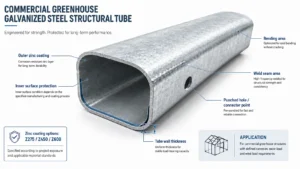
4. Weld Seam Quality
Many greenhouse tubes are manufactured from formed strip steel with a longitudinal weld seam.
The supplier should control:
- weld continuity;
- seam geometry;
- surface condition;
- coating coverage around the seam;
- cracking or coating damage during bending;
- compatibility with punching and connector placement.
A visually galvanized surface does not, by itself, confirm the condition of the weld seam or the quality of the underlying tube.
5. Bending and Forming Areas
Arch members and curved roof components are often bent after tube production.
The coating and steel substrate must remain suitable for the required forming process. Project teams should inspect or verify:
- surface cracking;
- flaking;
- local deformation;
- tube flattening;
- dimensional consistency;
- arch radius;
- alignment with connection points.
6. Punched Holes and Cut Edges
Punched holes, drilled holes and cut ends create localized areas that deserve additional attention.
The RFQ should clarify:
- whether holes are made before or after galvanizing;
- how exposed edges are protected;
- whether repair coating is required;
- how damaged zones are inspected;
- whether hole locations match connector drawings.
This is particularly important where moisture can remain trapped around overlapping plates, clamps or bolted connections.
Z275, Z450, Z600 and 300 g/m²: What Do They Mean?
Z275, Z450 and Z600 are commonly used zinc coating mass designations.
In simplified terms:
| Zinc coating designation | Nominal coating mass | Project interpretation |
|---|---|---|
| Z275 | 275 g/m² | Baseline coating mass for conditions assessed as lower or moderate corrosion exposure |
| Z450 | 450 g/m² | Higher coating reserve for more demanding humidity, lifecycle or maintenance conditions |
| Z600 | 600 g/m² | Heavier coating reserve for severe or high-consequence exposure conditions |
The coating mass is normally expressed as the total mass over both sides of the coated sheet or strip under the applicable standard.
This point matters when a buyer requests 300 g/m² galvanization.
The project team should not rely on the number alone. It should clarify:
- Which standard defines the coating?
- Does 300 g/m² mean total coating mass over both sides?
- Which structural members are included?
- Is the material continuously galvanized before forming?
- Are fabricated components galvanized after fabrication?
- What inspection or material documentation will be provided?
- How will welds, cuts and punched areas be treated?
A request for “300 g/m² galvanized tube” may therefore require further technical clarification before it can be compared with Z275, Z450 or another specification.
For a more detailed project-selection framework, see our guide to Z275, Z450 and Z600 zinc coating options for greenhouse structures.
Continuous Galvanizing and After-Fabrication Hot-Dip Galvanizing Are Not the Same
Commercial greenhouse components may be produced using different galvanizing routes.
Continuously Galvanized Material
Steel strip or sheet is zinc-coated in a continuous production line before it is formed into tubes or profiles.
Potential advantages include:
- controlled coating mass;
- efficient large-volume production;
- consistent surface appearance;
- suitability for roll forming and tube manufacturing.
However, fabrication steps such as welding, cutting and punching must still be managed properly.
Hot-Dip Galvanizing After Fabrication
A completed steel component or welded assembly is immersed in molten zinc after fabrication.
Potential advantages include:
- coating of the completed component;
- protection around many fabricated surfaces;
- suitability for specific heavy-duty members or connection components.
However, coating thickness, drainage holes, venting, distortion, surface finish and dimensional fit must be considered.
Neither method should be described as universally superior.
The project specification should identify:
- the structural member;
- product form;
- galvanizing method;
- applicable standard;
- required coating level;
- inspection requirement;
- repair procedure for damaged areas.
This avoids comparing quotations that use the same word—“galvanized”—but refer to materially different products.
Zinc Coating Is Not a Substitute for Structural Design
One of the most important distinctions in greenhouse procurement is:
Zinc coating protects steel against corrosion; it does not determine whether the greenhouse can resist snow or wind loads.
Structural resistance depends on the complete system, including:
- steel grade;
- section geometry;
- wall thickness;
- span;
- bay spacing;
- column spacing;
- roof shape;
- purlin arrangement;
- gutter design;
- bracing;
- connections;
- anchorage;
- foundation conditions;
- covering behavior;
- project-specific load combinations.
A Z600 member can still be structurally inadequate if its section is undersized.
Likewise, a properly engineered Z275 structure may be structurally strong but may require a different corrosion strategy if the project is located in a highly aggressive coastal or humid environment.
Structural design and corrosion protection must therefore be evaluated together, but they must not be confused.
Galvanized Greenhouse Structures for Heavy Snow
Snow-load projects require more than selecting a “strong greenhouse.”
The project team should establish:
- project location;
- governing snow criteria;
- elevation;
- roof geometry;
- heated or unheated operating assumptions;
- potential snow accumulation;
- drifting or unbalanced loading conditions;
- gutter valleys and adjacent roof effects;
- covering material;
- maintenance and snow-removal assumptions.
Roof Shape Matters
Round-roof, Gothic and angular-roof greenhouse structures do not shed snow in exactly the same way.
A steeper roof profile may improve snow shedding under some conditions, but the final design must still account for the applicable load cases and local requirements.
Snow can also accumulate around:
- gutters;
- roof transitions;
- vents;
- adjacent structures;
- areas sheltered from wind;
- multi-span valleys.
For this reason, “angular roof” or “Gothic roof” should not be treated as an automatic snow-load guarantee.
Covering Material Matters
Plastic film, polycarbonate panels and glass create different structural interfaces.
The covering affects:
- dead load;
- load distribution;
- connection details;
- purlin spacing;
- deflection limits;
- panel support;
- retention systems;
- local failure behavior.
A greenhouse structure initially designed for plastic film should not automatically be assumed suitable for polycarbonate panels without review.
Galvanized Greenhouse Structures for Strong Wind
Wind resistance depends on the full load path.
Wind pressures act on the covering and transfer through:
- covering fasteners or retention profiles;
- local framing and purlins;
- arches, rafters or primary frames;
- columns and bracing;
- base connections;
- anchors and foundations.
Strong-wind projects should define:
- project location;
- governing wind criteria;
- terrain or exposure;
- greenhouse height;
- roof form;
- building length and width;
- doors and vents;
- roll-up side assumptions;
- dominant openings;
- storm operating condition;
- equipment and suspended loads;
- foundation design responsibility.
Openings are particularly important.
If doors, vents or sidewalls are open during a wind event, internal pressure can combine with external roof suction and increase uplift demand.
A supplier should therefore avoid providing only a generic “wind rating.” The design basis, opening assumptions, bracing arrangement and foundation reactions should be documented.
See our detailed article on how wind load affects commercial greenhouse structure design.
Round-Roof or Angular-Roof Greenhouse Structure?
The correct roof form depends on the project—not only on appearance.
Round-Roof Structures
Round or arched greenhouse structures are commonly selected for:
- film-covered projects;
- repeatable commercial bays;
- efficient arch production;
- moderate structural spans;
- scalable multi-span layouts.
Key checks include:
- arch section;
- bending quality;
- arch spacing;
- purlin arrangement;
- film-retention system;
- snow accumulation assumptions;
- wind uplift and anchorage.
Angular-Roof or Gothic Structures
Angular or Gothic roof forms may provide:
- greater ridge height;
- more internal air volume;
- steeper drainage surfaces;
- different snow-shedding behavior;
- compatibility with particular ventilation layouts.
Key checks include:
- rafter connections;
- ridge details;
- gutter nodes;
- local bending;
- covering support;
- bracing;
- roof-to-column load transfer.
Neither roof type is universally better.
The decision should be based on climate, covering system, span, internal clearance, production requirements and local engineering criteria.
Plastic Film and Polycarbonate Require Different Structural Interfaces
A galvanized steel greenhouse frame should be coordinated with its covering system before member spacing and connection details are finalized.
Plastic Film Greenhouse Structures
Film-covered structures commonly require coordination of:
- arch spacing;
- film-locking profiles;
- wire or locking-channel interfaces;
- roll-up side systems;
- end-wall framing;
- wind retention;
- replacement access.
Film is relatively lightweight, but its flexibility makes edge retention, tension and wind behavior important.
Polycarbonate Greenhouse Structures
Polycarbonate panel structures commonly require coordination of:
- panel dimensions;
- purlin spacing;
- glazing profiles;
- thermal expansion allowance;
- support continuity;
- fastener spacing;
- water sealing;
- deflection limits.
Rigid panels can impose different dead loads and local support requirements from plastic film.
The structure supplier and system integrator should therefore freeze the covering type and interface requirements before final production drawings are released.
You can also review our commercial polycarbonate greenhouse structure for the structural role of rigid panel support.
Connection Compatibility Is Part of Structure Quality
Commercial greenhouse failures and installation delays do not always begin with primary steel members. They often begin at small but repeated details.
Connection items may include:
- arch-to-purlin clamps;
- gutter joints;
- column-to-gutter connections;
- ridge connections;
- bracing brackets;
- base plates;
- foundation anchors;
- film-lock profiles;
- glazing-support profiles;
- bolts, screws and fasteners.
Before production, the supplier should confirm:
- tube and profile dimensions;
- hole diameter and location;
- bolt grade;
- clamp fit;
- connection tolerance;
- coating allowance;
- assembly direction;
- component identification;
- replacement-part logic.
A high-quality galvanized tube does not eliminate the risk of a poorly fitting connector.
For large multi-span projects, repeated connection errors can affect installation speed, alignment and load transfer throughout the greenhouse block.
How EPC Teams Should Evaluate a Galvanized Greenhouse Structure Supplier
The following checklist can be used during supplier comparison.
| Evaluation item | What should be confirmed | Why it matters |
|---|---|---|
| Project design basis | Location, wind, snow, geometry, openings and covering | Prevents quotations based on incomplete assumptions |
| Steel specification | Grade, dimensions, thickness and tolerance | Supports structural consistency |
| Zinc coating | Designation, standard, process and member scope | Prevents vague “heavy galvanized” claims |
| Fabrication quality | Welding, bending, punching and cutting | Affects fit, durability and assembly |
| Structural calculations | Load cases, assumptions and reactions | Connects material supply to project demand |
| Connection details | Clamps, brackets, bolts and tolerances | Supports installation and load transfer |
| Covering compatibility | Film, polycarbonate, glass or other system | Prevents structural-interface conflicts |
| BOM | Member identification, quantity and specification | Supports procurement and receiving |
| Packing list | Bundle and component identification | Supports unloading and site sorting |
| Drawings | Plans, sections, connections and member codes | Supports review and installation |
| Installation guidance | Sequence and key structural notes | Reduces site execution risk |
| Scope boundary | Supplier, EPC and integrator responsibilities | Prevents responsibility gaps |
A useful supplier assessment should therefore ask:
Can this supplier connect project conditions to the structure, material specification, documentation and delivered package?
That question is more valuable than asking only:
What is your price per square meter?
For a broader procurement checklist, see How EPC Teams Evaluate Greenhouse Structure Suppliers.
Documents a Galvanized Greenhouse Structure Supplier Should Provide
The exact documentation package depends on the project scope and contract stage. A practical commercial package may include:
Design Basis Information
- project location;
- design criteria;
- wind and snow assumptions;
- greenhouse geometry;
- roof form;
- covering type;
- opening assumptions;
- stated exclusions.
Structural Information
- layout drawings;
- elevations and sections;
- member schedules;
- bracing arrangement;
- connection details;
- foundation reactions or interface requirements;
- design calculations when included in the agreed scope.
Material Information
- steel grade;
- member dimensions;
- wall thickness;
- zinc coating designation;
- applicable standard;
- galvanizing method;
- fastener or connector specification.
Procurement and Delivery Information
- BOM;
- packing list;
- bundle identification;
- container-loading information;
- replacement-part identification;
- shipment quantities.
Installation Information
- component codes;
- assembly sequence;
- critical connection notes;
- installation drawings;
- revision status;
- interface notes for locally supplied systems.
Read more about the recommended deliverables in our commercial greenhouse structure engineering package guide.
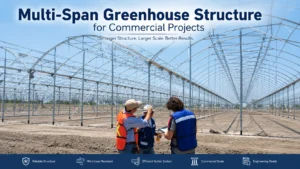
Multi-Span Greenhouse Structures Need Coordinated Durability Decisions
A multi-span greenhouse contains repeated bays connected through columns, gutters, roof members and bracing systems.
This creates clear commercial advantages:
- scalable project layouts;
- efficient land use;
- repeatable manufacturing;
- phased expansion;
- continuous growing space;
- compatibility with local greenhouse systems.
It also means that corrosion or connection issues at repeated structural nodes can affect a large area.
Critical zones may include:
- gutter lines;
- column bases;
- roof-to-column connections;
- overlapping members;
- bracing nodes;
- drainage areas;
- irrigation-adjacent zones;
- cut and punched connection points.
For this reason, zinc coating selection should be coordinated with:
- greenhouse layout;
- expected humidity;
- project lifespan;
- maintenance access;
- expansion plan;
- connection detailing;
- local corrosion exposure.
CHIYANG supplies commercial multi-span greenhouse structures for EPC teams, greenhouse integrators and commercial growers, with project-based structural and documentation review.
Common Procurement Mistakes
Mistake 1: Comparing Only the Zinc Number
Z275, Z450 or Z600 does not describe steel grade, wall thickness, tube quality, structural capacity or fabrication method.
Mistake 2: Treating “Hot-Dip Galvanized” as a Complete Specification
The RFQ should clarify whether the material is continuously galvanized before forming or galvanized after fabrication.
Mistake 3: Selecting Wall Thickness Without a Load Basis
Tube thickness should be connected to structural demand, not selected only from a standard supplier catalogue.
Mistake 4: Ignoring Welds, Holes and Cut Edges
Localized fabrication zones may require separate inspection or repair procedures.
Mistake 5: Changing the Covering After Structural Design
Replacing film with polycarbonate or another rigid covering may affect dead load, member spacing and connection requirements.
Mistake 6: Using a Generic Wind or Snow Rating
The design should state location, criteria, geometry, openings and other project assumptions.
Mistake 7: Reviewing the Frame but Not the Documentation
Missing or inconsistent BOMs, drawings and packing identification can create delays even when the steel itself is acceptable.
Where CHIYANG GREENHOUSE Fits
CHIYANG GREENHOUSE is positioned as a structure-first commercial greenhouse supplier.
We support EPC teams, greenhouse integrators and commercial growers with project-based greenhouse structure supply, including:
- galvanized steel structural frames;
- multi-span, Gothic, Venlo and polycarbonate greenhouse structures;
- project-specific material review;
- zinc coating option discussion;
- structural drawings and member schedules;
- BOM and packing information;
- installation reference documentation;
- export delivery coordination.
CHIYANG is not positioned as the local turnkey system integrator.
Climate control, irrigation, fertigation, automation, shading and locally executed installation systems are normally selected and integrated by the project’s EPC team or greenhouse integrator.
This responsibility boundary allows the structural package to remain clear while supporting coordination with locally selected greenhouse systems.
Conclusion: Select the Complete Structural Package, Not Only the Coating
A galvanized greenhouse structure supplier should be evaluated as part of the complete commercial project delivery chain.
Zinc coating is important, but it is only one part of the decision.
EPC teams and greenhouse integrators should evaluate:
- steel grade;
- tube dimensions;
- wall thickness;
- galvanizing process;
- zinc coating designation;
- weld and fabrication quality;
- snow and wind design assumptions;
- roof form;
- covering compatibility;
- connections and anchors;
- BOM accuracy;
- drawings;
- packing;
- installation information.
The best supplier is not necessarily the one offering the highest zinc number or the lowest steel price.
It is the supplier that can connect the project environment, structural requirements, corrosion strategy, fabrication details and documentation into one coordinated package.
Planning a Commercial Greenhouse Project?
Send us your:
- project location;
- greenhouse area;
- preferred structure type;
- covering material;
- available wind or snow criteria;
- required zinc coating;
- project stage;
- structural drawings or preliminary layout.
CHIYANG GREENHOUSE can review the structural scope and help define the information required before quotation and production.
Request a Galvanized Structure Review
Frequently Asked Questions
What is a galvanized greenhouse structure supplier?
A galvanized greenhouse structure supplier provides steel columns, arches, purlins, gutters, bracing, connections and related documentation with a corrosion-protection specification suitable for commercial greenhouse projects.
What should EPC teams check when selecting a galvanized greenhouse supplier?
EPC teams should check the structural design basis, steel grade, tube dimensions, wall thickness, zinc coating, galvanizing method, fabrication quality, connections, BOM, drawings, packing information and scope boundary.
What is the difference between galvanized pipe and a galvanized greenhouse structure?
Galvanized pipe is an individual material product. A galvanized greenhouse structure is a coordinated structural system consisting of pipes, profiles, connections, bracing, covering interfaces, anchorage and project documentation.
Is Z275 enough for a commercial greenhouse structure?
Z275 may be suitable for some lower- or moderate-exposure projects, but it should not be treated as a universal specification. The final choice should consider humidity, salinity, condensation, design life, maintenance access and the applicable material standard.
Should a greenhouse project use Z275, Z450 or Z600?
The coating should be selected according to the project exposure and lifecycle requirements. Higher coating mass generally provides a larger corrosion-protection reserve, but the correct choice should be confirmed against the environment, structural member and maintenance strategy.
Is 300 g/m² galvanization the same as Z275?
Not exactly. A 300 g/m² request is numerically close to Z275 but must still be clarified by standard, measurement method, product form, member scope and whether the value represents total coating mass over both sides.
Is galvanized steel suitable for heavy-snow greenhouse projects?
Galvanized steel can be used for heavy-snow greenhouse structures, but snow resistance depends on member sizes, roof geometry, spacing, bracing, connections and foundations—not on zinc coating alone.
Is galvanized steel suitable for strong-wind greenhouse projects?
Yes, when the complete structure is engineered using a defined wind design basis. Wind resistance depends on the covering, frames, bracing, connections, anchorage, foundations and opening assumptions.
Does a polycarbonate greenhouse require a different frame from a plastic-film greenhouse?
It may. Polycarbonate panels can require different purlin spacing, support profiles, connection details, deflection limits and dead-load allowances. The covering system should be confirmed before final structural design.
Which is better for snow: a round roof or an angular roof?
Neither is automatically superior for every project. Roof slope and geometry influence snow behavior, but local snow criteria, accumulation, drifting, span and structural details must also be evaluated.
What documents should a greenhouse structure supplier provide?
Depending on scope, the supplier should provide design assumptions, drawings, member schedules, material specifications, BOM, connection details, packing list, installation information and foundation interface requirements.
Does CHIYANG provide turnkey greenhouse systems?
CHIYANG focuses on greenhouse structure supply and related engineering documentation. Climate control, irrigation, fertigation, automation and local system integration are generally handled by local EPC teams or greenhouse integrators.