Wind load is one of the fastest ways a commercial greenhouse structure design project gets pushed into redesign—usually late, and usually at a higher cost than expected. In many cases, the issue is not that wind was ignored, but that the design basis for commercial greenhouse structure design was never fully frozen early enough: site conditions, openings, exposure, height, and system interface loads were still moving while structural assumptions had already been made. For U.S. projects, site-specific wind parameters can be reviewed using the ASCE Hazard Tool before structural assumptions are finalized.
This article is written for greenhouse integrators, EPC teams, and engineering-led growers evaluating commercial greenhouse structure design for real project execution. Instead of turning wind design into a code memo, it focuses on the practical inputs that affect permitting, procurement, and installation readiness: wind design basis, opening assumptions, internal pressure behavior, load-path logic, and the engineering documentation needed to keep commercial greenhouse structure design project execution on track.
1) Why does wind load often govern a commercial greenhouse structure
Understanding the fundamental principles of commercial greenhouse structure design is crucial for success.
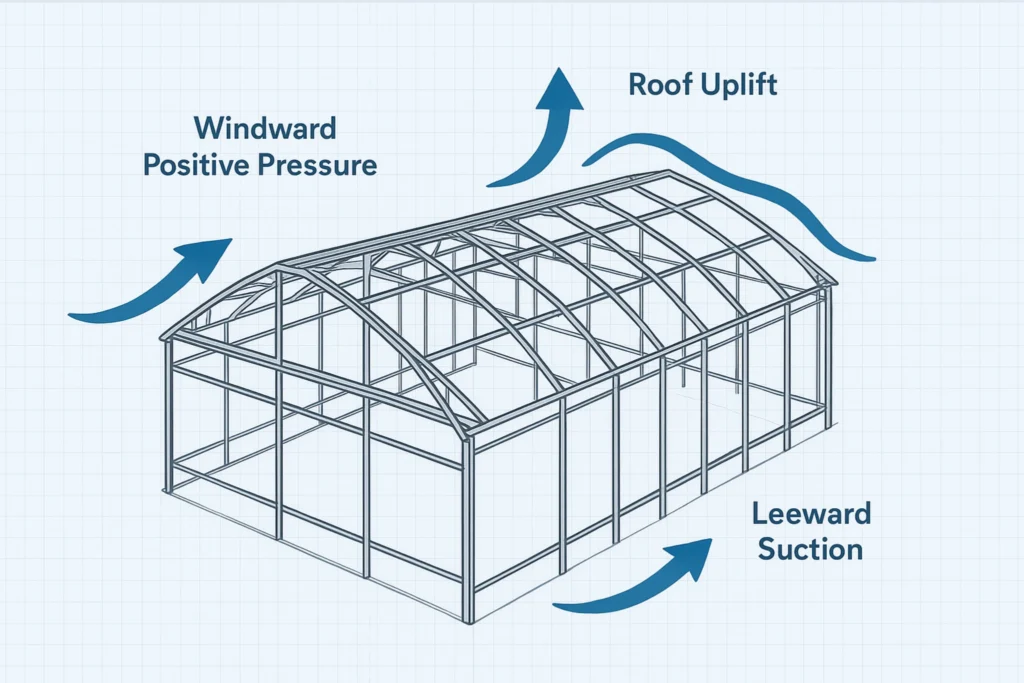
Wind is not a single sideways push. It is pressure distributed over surfaces:
- positive pressure on windward walls
- suction on leeward walls
Commercial greenhouse structure design requires understanding of both internal and external pressures.
- suction on roof surfaces that can drive uplift
Wind becomes especially important in greenhouse structures because of the combination of:
- lightweight envelope materials relative to industrial buildings
Effective commercial greenhouse structure design incorporates operable openings to manage airflow.
- long spans and repeated bays
- high exposed surface area
- operable openings such as vents, doors, and roll-up sides that affect internal pressure behavior
In project terms, wind load typically shows up as:
- uplift demand that drives base plates, anchors, and foundation reactions
- racking forces that drive bracing strategy and connection detailing
- envelope and component demand, where clips, fasteners, or glazing retention often become the first failure points if not properly addressed
Practical risk: The most painful wind-driven redesigns are usually not caused by “higher wind speed” alone. They are often triggered by late changes in project conditions—height, exposure, openings, or equipment interfaces—that make the original assumptions invalid.
2) Define the design basis: the inputs your engineer actually needs
The inputs for effective commercial greenhouse structure design must be accurately defined and communicated.
Most teams do not fail on analysis. They fail on inputs.
The fastest way to keep commercial greenhouse structure design on track is to define the wind design basis as early as possible and assign clear ownership to each assumption.
A design-basis checklist you can include in an RFQ or EPC kickoff
A. Site and permitting context
- Project location (address or coordinates)
- Local permitting pathway and governing authority
- Site elevation or topography if relevant
B. Wind criteria inputs
- Basic wind criteria required by the local jurisdiction
- Risk or importance classification assumptions
- Terrain or exposure assumptions (open terrain, suburban, coastal, etc.)
C. Geometry that drives wind pressure
The geometry of a structure heavily influences the wind design criteria in commercial greenhouse structure design.
- Mean roof height or eave height
- Roof form (for example venlo, gothic, multi-span arrangement)
- Bay count and block layout
- End-wall conditions, including doors and large equipment penetrations
D. Openings and operating assumptions
- Normal operating openings versus storm-condition assumptions
- Any requirement for wind locks or closure logic for vents and doors
- Whether any opening could act as a dominant opening under wind
E. Load interfaces owned by integrator or EPC
- Suspended loads such as pipes, screens, trellis systems, or utilities
- Concentrated equipment loads
- Attachments to primary frames or bracing lines
F. Foundation boundary and reactions
- Who designs the foundations
- Assumed base fixity or embedment concept
- Required output such as uplift, shear, and overturning reactions
If an input is missing, say so clearly. “To be confirmed” is acceptable as long as there is a decision owner and a freeze milestone.
3) Enclosure, openings, and internal pressure: the multiplier many projects underestimate
If one section can prevent redesign churn, it is this one.
Greenhouses often include vents, louvers, doors, ridge openings, and sometimes large operable sections. These features do not only affect ventilation. They also affect internal pressure, which combines with external pressures to produce net loads on walls and roofs.
In practical terms:
It is crucial to understand internal pressure dynamics in commercial greenhouse structure design.
- if wind enters easily through a large windward opening, internal pressure can rise
- if internal pressure pushes upward while external roof suction also pulls upward, roof uplift demand increases
- if opening assumptions change after design has started, the structural basis may need to be rechecked
A practical approach for integrators and EPC teams
Document the design-storm operating state
Are vents assumed closed? Are doors assumed closed? If not, which openings are considered open?
Treat opening strategy as a change-control item
If vent area, door locations, or roll-up side behavior changes, the wind basis likely changes as well.
Clarify who owns the closure hardware and control logic
If the structural design assumes closures during wind events, the project must provide the means to achieve those assumptions.
This is not about overcomplicating the design. It is about avoiding the worst possible timing for redesign—after layout, procurement, or foundation work has already started.
4) Wind load greenhouse design is load-path engineering, not a generic “wind rating”
Effective commercial greenhouse structure design is essential for resilient agricultural practices.
A greenhouse does not resist wind as a single object. It resists wind through a load path:
- Surface pressures act on cladding, glazing, and local framing
- Loads transfer into purlins, rafters, frames, and columns
- Lateral forces resolve through bracing systems and frame action
- Reactions accumulate at base connections and foundations as shear, uplift, and overturning demand
This load-path view matters because it prevents two common mistakes:
- focusing only on member sizing while ignoring connections, bracing nodes, and anchor demand
- treating envelope attachments as secondary shop details even when localized suction may govern
If an RFQ or scope statement says only “wind-rated greenhouse,” that is too vague. A better requirement is:
Engineered greenhouse structure with a defined wind design basis, identified bracing scheme, and documented foundation reactions under governing load combinations.
Clarity in documentation bolsters the integrity of commercial greenhouse structure design.
That wording is still readable, but it forces the work to be traceable.
5) Common wind-driven failure modes and the engineering controls that address them
Good greenhouse structural engineering is not just about checking strength. It is about designing against failure modes.
Roof uplift and net suction
Roof suction often governs.
If internal pressure increases because of openings, uplift demand can rise further.
Engineering control: design members, connections, and anchorage for uplift, not just gravity.
Racking and progressive geometry loss
Racking is a lateral distortion. Even without a member fracture, racking can:
- damage glazing retention
- overload clips and fasteners
- shift loads into unintended paths
Engineering control: provide a clear bracing strategy and connection detailing that limits drift and preserves geometry.
Connection, anchorage, and “small detail” failures
Many wind failures begin with relatively small details:
- under-designed fastener patterns
- weak bracketry at bracing nodes
- insufficient uplift resistance at base connections
Engineering control: demand-based detailing and explicit connection requirements in drawings and calculations, rather than generic “typical” notes with no load basis behind them.
6) Execution and Documentation: Preventing Redesign and Permit Delays
Designing for wind loads is a critical component of successful commercial greenhouse structure design.
Execution and permitting should follow the same design basis. If project assumptions change during execution, the documentation package quickly becomes unreliable. If documentation is incomplete, permitting and site coordination slow down.
A simple workflow for wind-based control
Step 1: Freeze the design basis early
Confirm site, exposure, geometry, openings, and interface loads as early as possible, and assign a clear owner to each input.
Step 2: Define redesign triggers
Re-checks are typically required when the project changes in ways that affect wind demand, such as:
- site or exposure assumptions
- roof or eave height
- bay count or block layout
- vent area, door placement, or end-wall openings
- hanging systems or equipment loads
- foundation concept or base assumptions
Step 3: Enforce revision control
Calculations and drawings must follow the same revision baseline. One of the most common execution risks is using updated drawings with outdated calculations.
What engineering documentation should include
For commercial greenhouse projects, documentation should remain traceable from design assumptions to structural output. A practical package typically includes:
- Design basis sheet: code basis, wind inputs, exposure, openings, and calculation geometry
- Structural calculations: governing load cases, uplift and lateral checks, and stated assumptions
Clear documentation in commercial greenhouse structure design ensures accountability and traceability.
- Permit/construction drawings: plans, elevations, sections, member identification, bay layout, and bracing layout
- Foundation reactions/interface requirements: uplift, shear, overturning, and required support conditions
- Critical connection details: bracing nodes, base plates, critical joints, and opening-related framing details
- Revision log: what changed, when, and why
For smoother permitting, it is also helpful to align early with the local authority so that submitted documentation matches actual permit expectations.
7) Where CHIYANG GREENHOUSE Fits: Structure Supply + Engineering Documentation
For role clarity in commercial greenhouse projects:
Partnerships in commercial greenhouse structure design can enhance project outcomes.
CHIYANG GREENHOUSE supplies greenhouse structures and related engineering documentation.
This typically includes structure design coordination, structural drawings, member schedules, and project-based documentation required to support procurement, permitting, and installation planning.
Working with experienced professionals in commercial greenhouse structure design maximizes project efficiency.
CHIYANG GREENHOUSE is not positioned as a turnkey greenhouse contractor.
Climate control, irrigation, fertigation, automation, shading systems, and overall system integration are typically handled by local integrators or EPC teams based on project requirements and regional execution practices.
If your project is still in the early design stage, the most valuable next step is usually to confirm the wind design basis inputs—especially openings, exposure assumptions, and interface loads—before structural assumptions are locked into drawings, quotations, and foundation planning.
Prioritizing the wind design basis is a critical step in commercial greenhouse structure design.
FAQ
1) What does “wind load greenhouse structure” mean in practical terms?
It means the greenhouse structure is engineered using a documented design basis—site conditions, exposure, openings, geometry, and boundary assumptions—rather than a generic “wind-rated” claim.
2) Why do vents, doors, and other openings affect wind loads so much?
Because openings change internal pressure, in certain operating conditions, internal pressure can combine with external roof suction and significantly increase uplift demand.
Proper management of openings is vital in commercial greenhouse structure design.
3) What should an EPC team include in an RFQ for commercial greenhouse structure design?
At minimum: project location, permitting basis, wind criteria assumptions, terrain or exposure assumptions, greenhouse geometry, enclosure and opening assumptions, interface loads from integrator-owned systems, and required engineering deliverables.
Typical modes include roof uplift, bay racking, connection failures, fastener failures, and inadequate base anchorage under uplift and lateral demand.
Risk assessment plays a significant role in commercial greenhouse structure design.
5) What should greenhouse engineering documentation include for permitting and execution?
A practical package should include a design basis sheet, structural calculations, permit or construction drawings, foundation reactions or interface requirements, critical connection details, and clear revision control.
A comprehensive strategy in commercial greenhouse structure design reduces the likelihood of failures.
Strategic planning is essential to ensure commercial greenhouse structure design aligns with project goals.
Regulatory compliance is a necessary consideration in commercial greenhouse structure design.
References
Innovations in technology can enhance commercial greenhouse structure design efficiency.
- Greenhouse Mag — Dealing with greenhouse wind loads
Continuous improvement should be a goal in commercial greenhouse structure design processes.
- Engineering Express — Open, Closed, Partially Open, and Partially Enclosed Structures
Training and development are key to advancing skills in commercial greenhouse structure design.
- UConn Extension — Wind Loads on Greenhouses
Collaborative efforts in commercial greenhouse structure design yield better results.
- UMass Extension — Reducing Storm Damage to Your Greenhouses
- UMass Extension — Securing Building Permit for a Greenhouse
- NGMA — Design Consideration