

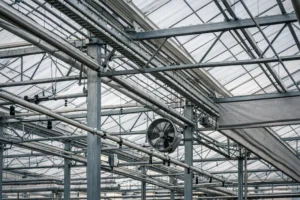
Commercial greenhouse structure design is never just a matter of selecting a familiar frame.
Two projects may appear similar on paper, yet require very different structural decisions once wind exposure, span targets, local climate, corrosion risk, and execution conditions are defined clearly. That is where many project problems begin: a frame that looks acceptable at concept stage becomes inadequate once real project conditions are applied.
For integrators, EPC teams, and engineering-led growers, the principle is straightforward: commercial greenhouse structure design must be project-specific. Wind, span, and climate are not secondary variables. They shape load demand, member sizing, deflection behavior, corrosion strategy, interface compatibility, and long-term operating risk.
This is why a greenhouse structure should not be approved too early based only on general dimensions or a previous project reference. Design choices that seem minor at the beginning often determine whether the structure remains stable, serviceable, repeatable, and easier to execute later.
Why Commercial Greenhouse Structure Design Cannot Be Standardized
Standardization is useful in manufacturing, but over-standardization in structural decision-making creates risk.
A commercial greenhouse structure is not judged only by its appearance or nominal size. It is judged by whether it can handle actual environmental loads, support intended interfaces, remain serviceable over time, and move through approval, transport, and installation without avoidable problems.
That is why a “standard frame” often becomes problematic when moved from one project context to another.
A design basis that works in a mild inland environment may not remain suitable in a high-wind or corrosive location. A span that looks efficient in concept drawings may behave very differently once stiffness, hanging loads, and deflection limits are reviewed. A corrosion protection level that appears adequate in one climate may become under-protective in another.
A better starting point is not: “Which standard frame do we usually use?”
A better starting point is:
- What is the project location?
- What wind basis should be used?
- What span logic is required?
- What climate and corrosion exposure will the structure face?
- What hanging loads and system interfaces must be reserved?
- What documentation will be needed before approval and execution?
When these questions are delayed, structural decisions become reactive instead of engineered.
How Wind Load Changes Structural Requirements
Wind is one of the most underestimated inputs in greenhouse projects because it affects more than the visible frame strength.
It influences:
- uplift behavior
- roof suction
- connection demand
- bracing requirements
- support reactions
- serviceability margins
- long-term reliability in vulnerable points
For that reason, wind load should be treated as a design-basis input from the beginning, not as a late correction.
Wind Defines the Load Envelope
Once wind conditions become more severe, the structural envelope changes. Member sizes, connection details, bracing logic, anchorage, and sometimes even configuration may need revision.
Two greenhouses with the same area do not automatically have the same structural requirements. Project location matters because local wind exposure can significantly change uplift intensity, connection force demand, and stability margins.
A frame that looks efficient under one wind basis may become too flexible, too lightly connected, or too vulnerable under another.
Uplift Is Not a Secondary Issue
Many buyers focus on visible frame members and underestimate uplift. In practice, uplift may become one of the most critical design drivers, especially in exposed regions.
If uplift is not addressed properly, the first signs of weakness may appear as:
- connection distress
- local deformation
- anchorage concern
- repeated maintenance
- lower confidence during storms
That is why wind should never be reduced to a simple “high-wind” label. It has to be translated into real structural consequences.
Wind Also Affects Execution
Higher wind demand rarely changes only engineering calculations. It often changes execution.
It may affect:
- steel quantity
- connection density
- erection sequence
- tolerance sensitivity
- installation complexity
- packing and logistics priorities
For EPC teams, this matters because structural decisions that look minor during design can directly influence labor efficiency, field coordination, and site risk.
Why Span Affects Stability, Material Demand, and Project Cost
Span is often treated as a layout choice. In reality, it is also a structural choice.
It affects stiffness, member demand, deflection control, hanging capacity, connection behavior, and downstream coordination.
Span Is Not Only Geometric Width
A wider span may create planning or operational advantages, but it also changes how the frame performs.
As the span increases, designers must review:
- bending demand
- member stiffness
- serviceability limits
- deflection under load
- connection performance
- suspended load compatibility
This means span selection is not just a dimensional preference. It influences how much steel is required, how stable the frame remains, and how practical downstream coordination becomes.
Deflection Control Matters in Real Projects
Structural adequacy is not only about avoiding failure. In commercial projects, serviceability matters.
If member deflection is not controlled properly, the result may affect:
- cladding behavior
- gutter alignment
- equipment interfaces
- hanging system stability
- long-term maintenance perception
A design may technically stand, yet still perform poorly in service if span-related deflection is underestimated.
Span Affects Downstream Interfaces
Wider spans can also influence how the structure works with:
- suspended irrigation
- shading components
- ventilation hardware
- cable routes
- maintenance access
- future system changes
For integrators and EPC teams, this means span should be checked not only against structural demand, but also against interface practicality.
A span that looks attractive in concept drawings may later create avoidable compromises if coordination is not addressed early.
How Climate Influences Corrosion Protection, Ventilation Logic, and Structural Choices
Climate should never be reduced to temperature alone.
In commercial greenhouse projects, climate affects structural design through:
- corrosion exposure
- snow or rain behavior
- humidity persistence
- thermal movement
- drainage expectations
- ventilation-related structural assumptions
That is why climate is not just background information. It is a structural input.
Corrosion Exposure Changes Protection Strategy
An inland dry environment, a humid area, and a coastal region do not justify the same corrosion assumptions.
Galvanizing level, protection expectations, and lifecycle risk must match the real exposure conditions. If corrosion class is underestimated, the structure may still be installed successfully, but long-term durability confidence will be weaker.
The consequence is not only technical. It also affects:
- maintenance cost
- replacement risk
- operator confidence
- asset perception
- repeat-project trust
Climate Affects Drainage and Roof Behavior
Rainfall intensity, condensation behavior, and moisture retention all matter.
They influence:
- drainage logic
- gutter performance
- local water concentration risk
- roof detailing expectations
- maintenance at vulnerable points
If environmental moisture behavior is ignored, performance problems often appear later as nuisance failures, repeated corrections, or avoidable complaints.
Thermal Movement Should Not Be Ignored
Temperature variation can affect alignment, connection stress, and long-term serviceability, especially in larger commercial layouts.
This is not always the first issue buyers focus on, but it contributes to hidden long-term tension if ignored in early design thinking.
Climate Also Shapes Structural Compatibility
Even when system integration is handled by local partners, climate still influences structural assumptions because the frame must remain compatible with real project ventilation and operating logic.
That is why climate should be treated as a design input from the beginning, not as a note added later.
Common Design Mistakes in Commercial Greenhouse Projects
Many greenhouse design problems do not come from a total lack of engineering. They come from assumptions that remain unchallenged for too long.
Mistake 1: Starting from a Standard Frame, Then Forcing the Project to Fit
Some teams begin with an existing frame and try to adapt the project around it. That may look efficient early, but often pushes complexity into approval, procurement, or site execution.
A stronger sequence is:
- confirm location and exposure
- define wind, span, and climate implications
- review interfaces and hanging logic
- align structure with actual project conditions
Mistake 2: Treating Wind as a Box to Tick
When wind is reduced to a generic label instead of a design input, uplift, bracing demand, and connection implications remain underdeveloped.
Mistake 3: Treating Span as Only a Commercial Preference
A larger span may support layout goals, but it can also increase structural demand, affect stiffness, and complicate coordination if not checked properly.
Mistake 4: Underestimating Corrosion Class
A project may be structurally adequate in the short term, yet strategically weak in long-term durability if the real environment is ignored.
Mistake 5: Locking the Design Too Early
Structural assumptions often change between concept stage, approval stage, and site execution. Teams that lock choices too early create avoidable rework later.
What Integrators, EPC Teams, and Buyers Should Confirm Early
Before approving a greenhouse structure, project teams should confirm the following.
1. Project Location and Wind Basis
Do not approve a frame before location-specific wind assumptions are clear.
2. Span Logic
The selected span should support not only layout goals, but also stiffness, serviceability, and interface practicality.
3. Climate and Corrosion Exposure
Protection level should match the real environment, not an optimistic average.
4. Hanging and Interface Expectations
If suspended loads, equipment interfaces, or future coordination will matter, they should be discussed before the frame is frozen.
5. Documentation Readiness
A commercial greenhouse project should not rely only on drawings or verbal assumptions. Depending on project stage, teams may need support such as:
- load-basis clarification
- structural specifications
- bill of materials
- packing list
- installation manual
- engineering package elements for review
6. Approval-Stage Change Risk
Ask which assumptions remain provisional. This reduces the chance of late revision after procurement has already started.
For EPC teams and integrators, this early verification step is not bureaucracy. It is risk control.
Why Long-Term Structural Thinking Affects OPEX and Repeatability
A greenhouse structure is not only a construction package. In serious commercial projects, it is part of a long-term operating asset.
That is why structural decisions should be judged not only by initial fabrication logic, but also by what they mean for:
- maintenance burden
- service stability
- operator confidence
- expansion repeatability
- future standardization
- lifecycle cost
A structure selected only for short-term savings may create long-term penalties through avoidable maintenance, reduced durability confidence, and weaker repeatability in future phases.
For engineering-led growers and repeat-project buyers, this distinction matters.
The strongest structure decisions are rarely the ones that look cheapest in isolation. They are the ones that remain stable, practical, and repeatable under real operating conditions.
Discuss Your Structural Requirements Early
If your project is still at concept stage, it is better to clarify structural requirements early than to correct them later.
For commercial greenhouse projects, wind basis, span strategy, climate exposure, hanging logic, and documentation readiness should be aligned before structure approval is finalized.
Primary CTA: Discuss Your Structural Requirements
Secondary CTA: Request Engineering Package
FAQ
What is commercial greenhouse structure design?
Commercial greenhouse structure design is the process of defining a greenhouse frame based on project-specific requirements such as wind load, span, climate exposure, serviceability, and interface conditions.
How does wind load affect greenhouse structure design?
Wind load affects uplift, connection force demand, bracing requirements, stability margins, and sometimes the overall configuration of the greenhouse structure.
Why does span matter in greenhouse design?
Span affects stiffness, member demand, deflection behavior, hanging capacity, cost balance, and downstream coordination. It is not only a geometric choice.
How should climate affect greenhouse structure decisions?
Climate influences corrosion risk, drainage behavior, thermal movement, and ventilation-related structural logic. It should be treated as a core design input from the beginning.
What should buyers confirm before approving a greenhouse structure?
Buyers should confirm project location, wind basis, span strategy, climate exposure, interface requirements, and documentation readiness before final approval.
