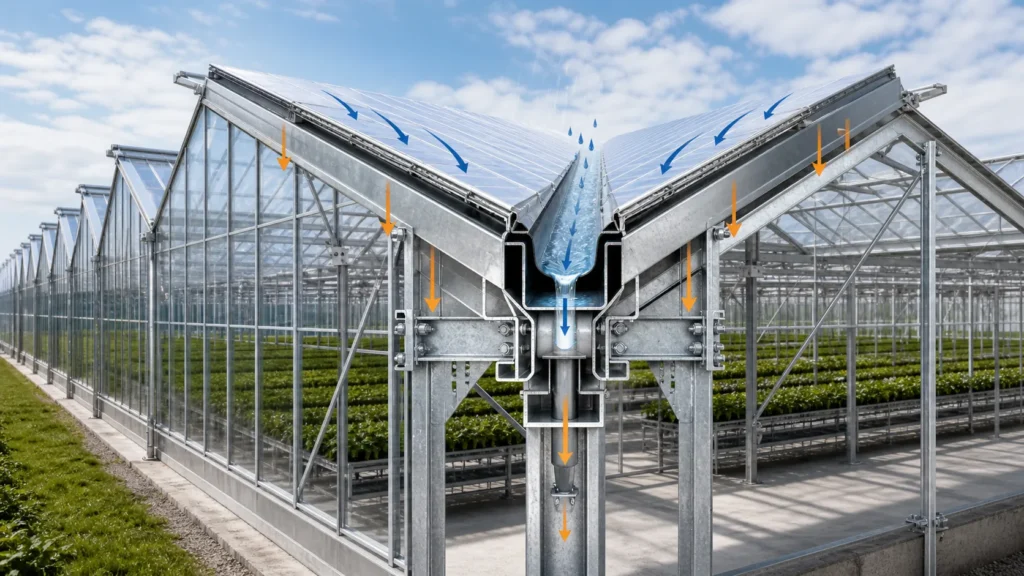
In commercial multi-span greenhouses, the gutter line is where two bays meet—and where a lot of long-term problems either get prevented or quietly designed in. Yes, it carries water. But in a ridge-and-furrow (gutter-connected) layout, it also acts as a structural joint: it is part of the interface that influences alignment, serviceability, and how loads find their way into columns.
Effective greenhouse gutter design is critical for the longevity of the structure.
Texas A&M AgriLife’s greenhouse structures overview describes ridge-and-furrow greenhouses as being connected at the eave by a common gutter—typically without an internal wall below the gutter—which is exactly why this line becomes a shared interface between spans (Aggie Horticulture — Greenhouse Structures).
For integrators, EPC teams, specifiers, and engineering-led growers, greenhouse gutter design is less about “does it drain?” and more about “does this joint stay reliable under real load cases and real movement?”
Understanding greenhouse gutter design helps prevent water damage over time.
Why the gutter line is a structural joint in multi-span greenhouses
In a multi-span system, the gutter sits at the eave line between adjacent bays. That makes it an interface where multiple requirements collide:
- Structural load transfer: gravity and lateral load effects have to move cleanly from roof members into columns.
- Serviceability: deflection and rotation at this line affect cladding fit-up (glass, polycarbonate, film lock profiles), seal continuity, and long-term leakage risk.
- Movement: long metal runs expand and contract; if you restrain them unintentionally, the joint will “solve” the stress by splitting seams or loosening fasteners.
- Durability: connection details concentrate water, crevices, cut edges, and dissimilar-metal contacts—exactly where corrosion starts.
Key Takeaway: Treat the gutter line like a structural interface that also happens to drain. If your drawings/specs treat it like “just drainage,” reliability issues tend to show up later—at joints, brackets, and leaks.
Proper greenhouse gutter design ensures that water flows away efficiently.
How loads move through a gutter-connected roof
The exact load path varies by geometry and vendor, but your review mindset shouldn’t:
- Roof gravity loads (dead load, live/maintenance loads, and snow) flow through rafters/purlins/trusses.
- Those loads resolve to reactions at the eave line.
- At the ridge-and-furrow interface, the gutter zone becomes the “handoff” into posts/columns and then to the foundation.
The gutter line is also where multi-span behavior matters:
- Adjacent bays may not be equally loaded (e.g., drifting snow, partial unbalanced loading, differential maintenance loads).
- If a connection detail assumes symmetrical load, the real-world case can push demand into the joint you least want to become “flexible.”
When you review multi-span greenhouse gutter design, don’t just ask “is the gutter sized?” Ask:
- Which components are intended to be load-bearing at the gutter line?
Every component in the greenhouse gutter design plays a role in overall stability.
- Which components are intended to slide (movement allowance) versus lock (force transfer)?
That single distinction—transfer vs. allow movement—drives most of the details that follow.
Clarity in greenhouse gutter design specifications is essential for successful installation.
Why valleys often govern gutter-line loading in multi-span greenhouses
Multi-span roofs create repeating peaks and valleys. The valley (gutter) is a natural collection line for both water and, in some climates, redistributed snow.
While greenhouse roofs have their own geometry and cladding systems, the underlying concept is familiar in structural codes: snow drift/unbalanced snow patterns can create localized surcharge loads near roof transitions and valleys.
As a supporting explainer—not a greenhouse-specific design manual—SkyCiv — Calculating roof snow drift loads w/ ASCE 7 shows how drift loads can exceed balanced loads and become a local governing case near transitions/valleys.
What this means during design/spec review:
- The gutter line may need to be checked for localized high demand, not only uniform roof loads.
- Gutter-zone components (brackets, splice plates, gutter-to-column connection detail) may govern due to the concentration.
Warning: If the design package shows only balanced roof snow without a clear valley/drift/unbalanced review (where applicable), you may be missing the load case that most directly stresses the gutter line.
For broader structural context around climate and load behavior, see How Wind, Span, and Climate Affect Commercial Greenhouse Structure Design.
Gutter-to-column connections: where load transfer becomes detail-dependent
The integrity of the greenhouse gutter design affects overall drainage performance.
The connection at gutter-to-column (or gutter-to-post) is the mechanical “truth” of the load path. In practice, it usually needs to do all of the following:
- Carry vertical reaction (gravity load effects at the eave).
- Maintain alignment so glazing/film interfaces don’t become sealant-dependent.
- Control rotation so slope/drainage intent is maintained under service loads.
- Allow movement where the system must expand/contract (or else you transfer thermal stress into seams and fasteners).
- Protect the durability envelope: avoid standing water traps and crevice conditions at the bracket line.
What to look for in drawings and submittals:
- Bracket type and spacing (not “as required”).
Greenhouse gutter design needs thorough review to ensure optimal performance.
- Fastener type and corrosion system (coating class, stainless vs coated, isolators).
- Clear “fixed point” vs “sliding point” logic. If everything is fixed, something else will move—usually at a seam.
If you’re evaluating a CHIYANG GREENHOUSE structure package, start from the commercial greenhouse structures overview and confirm where the vendor defines the greenhouse structural system and interfaces. For a multi-span typology reference, see the multi-span film greenhouse page.
How to review gutter-line serviceability without relying on one “magic number”
Regular maintenance checks can prolong the effectiveness of your greenhouse gutter design.
It’s tempting to ask for a single “allowable deflection” number. In reality, gutter serviceability is governed by what the gutter line supports and what interfaces it must keep aligned.
Instead of searching for a magic number, review deflection and rotation through three practical acceptance lenses:
A) Drainage performance under service load
- Does the gutter maintain enough slope to drain as intended under service gravity load?
- Is the design vulnerable to local low points that create ponding/ice?
B) Envelope alignment and seal continuity
- Will expected deflection/rotation compromise glazing gaskets, polycarbonate joints, film lock profiles, or sealant joints?
- Are there explicit tolerances for “fit-up” at the gutter line?
C) Reliability of joints and splices
- If the gutter line deflects, does it push movement into splices and sealant joints?
- Are joints detailed as structural and watertight, or do they rely on sealant-as-structure?
The takeaway for EPC review is simple: ask the engineer of record (or supplier) to state what the gutter line serviceability checks are protecting (drainage slope, cladding interface, joint durability), and show the governing load cases.
Thermal movement in long gutter runs: what drawings must show
Long metal gutters move. When they’re restrained, the stress does not disappear—it relocates into seams, fasteners, and sealant joints.
An enclosure-industry reference summarizing SMACNA guidance notes two practical points that are still useful during greenhouse gutter detail review:
- Expansion joints should be installed every 50 ft maximum.
- Expansion joints should be placed between downspout leaders because leaders lock the gutter into place.
See IIBEC — Internal Metal Gutter Design and Construction Considerations.
Investing in quality materials enhances your greenhouse gutter design.
As a supporting material-movement reference, Copper.org — Architectural Details: Hung Gutters gives practical spacing guidance for expansion joints on long runs. Use it as movement guidance, not as a greenhouse-specific structural standard.
What to verify on drawings/specs:
- Where are the anchors (fixed points) and where is slip allowed?
- Are expansion joints shown as a real detail—or implied as “sealant will take it”?
- Are leaders/downspouts unintentionally creating hard restraints at the worst locations?
Splices: avoid details that assume “sealant is forever.”
The same IIBEC reference highlights that lapping and bedding in sealant is not recommended for internal gutter splices because ponding over joints plus movement degrades the sealant joint—often without being noticed until damage occurs.
The greenhouse translation: if your splice detail depends on sealant to survive movement, you’ve created a maintenance and reliability liability at the gutter line.
Understanding the principles of greenhouse gutter design is crucial for builders.
Where corrosion starts at greenhouse gutter connections
Corrosion problems often begin where the design concentrates three conditions:
- Moisture + time (standing water or persistent wetting)
- Crevices (overlaps, unsealed laps, trapped debris)
- Exposed base metal (cut edges, drill holes, scratched coatings)
Cut edges are a well-documented initiation point for corrosion on galvanized steel. The American Galvanizers Association explains why exposed edges can corrode and how the surrounding zinc provides sacrificial protection. GalvInfo Note 3.6 summarizes galvanic/bimetallic and cut-edge corrosion behavior for galvanized products.
Innovation in greenhouse gutter design can lead to improved agricultural practices.
For spec review, translate that into connection-detail questions:
- Are field-cut edges sealed or protected (paint system, sealant strategy, or factory-finished edges)?
- Are fasteners and brackets compatible with the base material and coating system?
- Are dissimilar metals isolated where needed (washers, isolators, barrier coatings)?
- Does the detail avoid “water traps” at the bracket and splice line?
Pro Tip: Corrosion control is easier to design than to retrofit. If the design package doesn’t clearly address cut edges, fasteners, and dissimilar-metal contact at the gutter line, assume the field will create those conditions—and detail accordingly.
Utilizing best practices in greenhouse gutter design helps avoid common pitfalls.
What buyers and EPC teams should check in drawings and submittals
This checklist aids in evaluating greenhouse gutter design effectively.
Collaboration with experts is key to successful greenhouse gutter design.
Load path and structural intent
- Does the package explicitly state whether the gutter line is load-bearing (and which members transfer load into it)?
- Are governing load cases shown for the gutter line (dead, maintenance, snow, wind effects, unbalanced/drift where applicable)?
- Are reactions and connection forces provided for the gutter-to-column interface?
Understanding local weather patterns aids in effective greenhouse gutter design.
Valley loading review
- If the site is in a snow region, is there a valley/drift/unbalanced review that checks localized effects at valleys?
- Are alternate/unbalanced patterns considered (not just a single uniform case)?
Gutter-to-column details
- Is there a clear detail showing bracket type, fastener type, and spacing?
- Is the connection designed to control rotation/alignment at the gutter line?
- Is “fixed vs sliding” intent clearly defined (what is allowed to move, what is not)?
Serviceability and deflection
Regular updates in guidelines for greenhouse gutter design ensure compliance.
- Is the serviceability check defined in functional terms (drainage slope maintained, cladding alignment, joint durability)?
- Are tolerances stated for cladding/seal interfaces at the gutter line?
Movement and expansion-joint strategy
- Are expansion joints shown and detailed as real components (not “sealant allowances”)?
Proper planning of greenhouse gutter design can prevent costly mistakes.
- Are downspout leaders treated as anchors (and joints placed accordingly)?
- Are long runs segmented logically so that movement demand is realistic?
Corrosion control at connections
- Are cut edges/drilled holes protected (spec language + inspection hold points)?
Consider innovative solutions for modern greenhouse gutter design.
- Are dissimilar metals identified and isolated where needed?
- Are standing-water conditions avoided at splices and brackets?
Submittal completeness and installation notes
- Are splice details, sealant specs, and installation constraints included in the IFC set?
- Is there a clear maintenance access plan so strainers and leaders can actually be serviced?
Next steps
Understanding greenhouse gutter design is vital for sustainable practices.
If you’re aligning project requirements across structure, cladding, and drainage, start by defining interfaces and load cases early—before procurement locks in details that are difficult to revise.
For projects in Mexico and similar commercial markets, you can also review how structural decisions are positioned for integrators and EPC teams on our Mexico greenhouse structures page.
Engaging with stakeholders can enhance your greenhouse gutter design approach.
Discuss Your Structural Requirements
If you want a drawing/spec review focused on the gutter line (load path, valley snow risk, movement strategy, connection durability), contact CHIYANG GREENHOUSE here: Discuss Your Structural Requirements
Contacting professionals ensures your greenhouse gutter design meets industry standards.