For commercial greenhouse structures, zinc coating is not just a surface treatment. It is part of the structural lifecycle strategy.
In dry inland environments, a standard galvanized coating may perform well for many projects. But in high-humidity greenhouse interiors, coastal regions, or long-cycle commercial operations, the coating specification becomes a much more important engineering decision.
For integrators, EPC teams, and engineering-led growers, the question is not simply:
“Is the steel galvanized?”
The better question is:
“Is the zinc coating specification suitable for the project environment, expected service life, and maintenance plan?”
This article explains how Z275, Z450, and Z600 galvanized coating specifications differ, how corrosivity exposure affects coating selection, and why greenhouse structure buyers should evaluate zinc coating as part of long-term project risk control. Specifically, we will compare the Z275 vs Z450 vs Z600 options for optimal corrosion protection.
Why zinc coating selection matters in commercial greenhouse projects
Comparing Coating Options: Z275 vs Z450 vs Z600
A commercial greenhouse is not a light temporary shelter. In many projects, it is a long-term production asset expected to support crops, equipment, ventilation loads, hanging systems, irrigation lines, maintenance access, and repeated climate cycles.
That means corrosion protection should be considered before fabrication and shipment, not after rust appears on site.
High-humidity greenhouse environments can create different corrosion risks from ordinary outdoor steel structures. Even when the project is not located directly beside the sea, the greenhouse interior may experience:
- frequent condensation
- irrigation-related moisture
- fertilizer or chemical exposure
- limited air movement around structural joints
- long wet-dry cycles around gutters, columns, and connection points
For this reason, the zinc coating grade should be selected according to the actual exposure conditions of the greenhouse structure, not only according to a default material specification.
A low initial coating specification may reduce the purchase price, but it can increase maintenance pressure later. For commercial projects, premature corrosion may affect inspection, replacement cost, operating continuity, and the confidence of the owner or investor.
What Z275, Z450, and Z600 mean in project terms
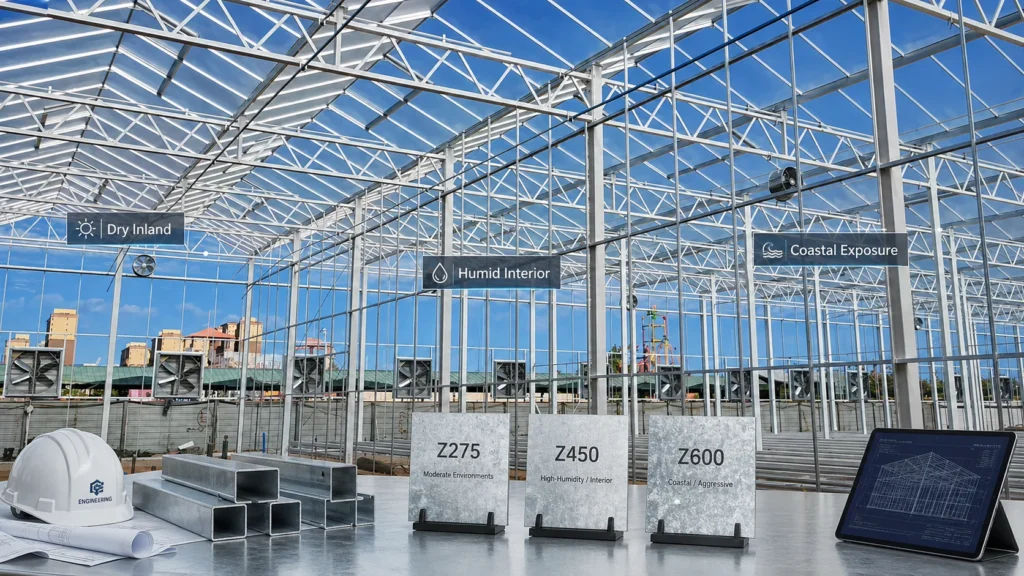
Z275, Z450, and Z600 are zinc coating mass designations for galvanized steel. In common galvanized steel specifications such as ASTM A653/A653M, these designations are used to distinguish different zinc coating mass levels.
For EPC teams, integrators, and project buyers, g/m² should not be read only as a material number. It is more useful to understand it as a protection reserve for different greenhouse project environments.
A higher coating mass generally means more sacrificial zinc is available before the steel substrate becomes exposed. In practical project terms, this helps buyers evaluate whether the structure is suitable for a dry inland site, a high-humidity commercial greenhouse, or a coastal project with higher corrosion exposure.
| Zinc coating grade | How project teams can understand it | Typical greenhouse project scenario |
|---|---|---|
| Z275 | Baseline galvanized coating for lower-risk environments | Dry inland projects, moderate humidity, standard commercial structures, and easier maintenance access |
| Z450 | Higher protection reserve for more demanding greenhouse environments | High-humidity interiors, multi-span commercial greenhouses, longer service life planning, and phased expansion projects |
| Z600 | Heavier coating option for severe exposure or difficult maintenance conditions | Coastal regions, high-salinity exposure, long-life assets, and high-value projects where corrosion repair would be difficult |
For many EPC teams, the decision should start with the project environment rather than the coating number itself.
Before choosing a zinc coating grade, the project team should ask:
- Is the project located in a dry inland area, a humid region, or a coastal zone?
- Will the greenhouse interior create frequent condensation or long wet-dry cycles?
- Is the structure expected to operate as a short-cycle project or a long-term commercial asset?
- Will key members such as gutters, column bases, and roof connections be easy to inspect and maintain after installation?
If the project conditions point toward higher humidity, coastal exposure, long service life, or difficult maintenance access, Z450 or Z600 may need to be reviewed instead of using a default baseline specification.
The goal is not to overspecify every greenhouse structure. The goal is to match the zinc coating grade to the project’s exposure environment, service life expectation, and maintenance strategy.
Zinc coating and service life: why more zinc usually means more protection time
Zinc protects steel by acting as a sacrificial coating. When exposed to atmospheric corrosion, zinc corrodes before the underlying steel. As long as enough zinc remains, the steel substrate is still protected.
This is why coating mass matters.
A simplified way to think about the relationship is:
Longer time to first maintenance = zinc coating thickness ÷ zinc corrosion rate
This is not a final engineering calculation, but it gives EPC teams a useful selection logic.
| Variable | Why it matters |
|---|---|
| Zinc coating mass | Defines how much sacrificial protection is available |
| Corrosivity category | Defines how aggressive the environment is |
| Time of wetness | Greenhouse humidity and condensation can increase exposure |
| Maintenance access | Some structural members are difficult to repaint after operation starts |
| Design life | A 10-year trial project and a 25-year commercial asset should not use the same selection logic |
For greenhouse projects, this shifts the conversation from “galvanized or not” to a more useful question:
“How long can this coating support the structure before maintenance becomes necessary under this exposure condition?”
This does not mean that a higher zinc coating grade is always the correct answer. It means the coating grade should be selected according to the project’s environment, structural importance, and lifecycle expectation.
Mapping corrosivity exposure to greenhouse environments
Corrosivity classification systems such as ISO 9223 are useful because they help project teams think about the exposure environment in a more structured way. Instead of relying only on vague descriptions such as “humid” or “coastal,” the project team can evaluate whether the structure faces low, moderate, high, or severe corrosion exposure.
For greenhouse structures, this framework is useful, but it should be applied with project judgment. A greenhouse may have a dry external climate but a humid internal microclimate.
| Project exposure condition | Typical corrosion concern | Coating selection logic |
|---|---|---|
| Dry inland site | Lower atmospheric moisture, limited salinity | Z275 may be acceptable for many standard projects |
| Humid inland greenhouse | Condensation, irrigation humidity, wet-dry cycles | Z450 may be considered for longer service life |
| Coastal greenhouse site | Salinity, wind-driven moisture, chloride exposure | Z450 or Z600 may be considered depending on severity |
| Severe coastal / industrial exposure | High salinity, aggressive pollutants, difficult maintenance | Z600 or other enhanced protection may be reviewed |
| High-value long-cycle asset | Financing period, expansion plan, long operation horizon | Higher coating grade may reduce lifecycle risk |
This table is not a substitute for local engineering review. Instead, it helps integrators and EPC teams ask the right project questions before the structure is manufactured.
Z275: suitable for lower-risk and moderate exposure projects
Z275 is widely used as a baseline galvanized coating specification. For many greenhouse structures in dry or moderate environments, it may offer a practical balance between corrosion protection and cost.
Z275 may be suitable when:
- the project is located in a dry inland area
- the greenhouse interior humidity is moderate
- the expected operating cycle is shorter
- maintenance access is relatively easy
- the owner is not requiring a long asset lifecycle
- the project budget is highly sensitive
However, Z275 should not be treated as a universal default. In high-humidity greenhouse interiors or coastal areas, the project team should review whether the coating mass is sufficient for the expected service life.
The risk is not that Z275 is “bad.” The risk is using Z275 without evaluating the exposure environment.
For EPC teams, the better question is:
“Is Z275 aligned with the corrosivity exposure, humidity condition, and maintenance plan of this greenhouse project?”
Z450: a stronger option for humid commercial greenhouse structures
Z450 provides a higher zinc coating mass than Z275 and is often a better fit for commercial greenhouse projects where humidity exposure and long-term structural reliability matter.
Z450 may be considered when:
- the greenhouse is used for high-humidity production
- condensation is expected around gutters, columns, or roof members
- the structure is part of a multi-phase commercial project
- the owner wants a longer time to first maintenance
- the project is inland but not low-risk from a humidity perspective
- the buyer is evaluating lifecycle cost, not just purchase price
For many engineering-led growers and integrators, Z450 can be a practical middle ground. It improves corrosion protection without immediately moving to the heavier specification level of Z600.
This is especially relevant for multi-span greenhouse structures, where corrosion at key nodes can be more difficult to address once the project is operating.
Areas that deserve special attention include:
- gutter lines
- column bases
- roof-to-column connections
- sidewall members exposed to condensation
- zones near irrigation, fertigation, or chemical storage
- bolted or overlapped steel connections
In these areas, the coating decision is not cosmetic. It directly affects long-term inspection, maintenance, and structural confidence.
Z600: for severe humidity, coastal exposure, and high-risk environments
Z600 provides a higher zinc coating mass than Z450 and is usually considered for more aggressive exposure conditions.
Z600 may be reviewed when:
- the project is near the coast
- the structure is exposed to salt-laden air
- the greenhouse is in a high-humidity or high-corrosion microclimate
- maintenance access will be difficult after installation
- the owner expects a longer asset life
- the greenhouse is part of a large commercial investment
- premature corrosion would create high operational or financial risk
For coastal greenhouse projects, the decision should not be based only on distance from the shoreline. Local wind direction, humidity, rainfall, salinity, industrial pollutants, and structure orientation can all affect corrosion exposure.
That is why a responsible specification should avoid vague language such as:
“heavy galvanized”
Instead, the project documents should define the actual coating requirement:
Z275, Z450, Z600, batch hot-dip galvanizing, or another agreed protection system, depending on the structural member and exposure condition.
In severe environments, Z600 may not be the only answer. Some projects may require batch hot-dip galvanizing, duplex coating, special maintenance planning, or separate treatment for connection zones. The correct solution depends on the project design basis.
Why greenhouse interiors can be more corrosive than they appear
Greenhouse corrosion is not only an external climate issue. It is also an internal microclimate issue.
Many commercial greenhouse structures are exposed to:
- warm and humid air
- repeated condensation
- water dripping at gutter lines
- chemical residues from crop production
- localized wet zones near irrigation or drainage
- trapped moisture at overlapped members
- reduced drying time around enclosed or shaded steel surfaces
This means a project located inland may still create corrosion conditions that are more aggressive than a normal outdoor rural environment.
For this reason, integrators and EPC teams should evaluate both:
- External exposure — coastal distance, rainfall, industrial pollution, regional climate
- Internal exposure — humidity, irrigation method, condensation risk, chemical environment, maintenance access
A greenhouse structure is not just standing in the climate. It is also operating inside a controlled agricultural environment.
That distinction matters.
Coating selection matrix for EPC and integrator teams
| Decision factor | Z275 | Z450 | Z600 |
|---|---|---|---|
| Dry inland environment | Often suitable | Optional upgrade | Usually not necessary |
| Humid greenhouse interior | May need review | Often suitable | Consider if severe |
| Coastal exposure | Use with caution | May be suitable for moderate exposure | Often reviewed for severe exposure |
| Long lifecycle expectation | Limited depending on environment | Stronger fit | Strongest among the three |
| Budget sensitivity | Lowest initial cost | Mid-range | Higher initial cost |
| Maintenance access difficulty | Less ideal if exposure is high | Better protection margin | Better protection margin |
| Multi-phase commercial project | Project-specific | Often practical | Suitable for high-risk environments |
| Documentation requirement | Should still be defined clearly | Should be recorded in specs | Should be recorded in specs |
This matrix is designed as a selection guide, not a universal specification table. Final coating selection should be confirmed according to project location, local standards, structure type, and engineering requirements.
A higher coating grade is not automatically the best answer for every project. The correct decision still depends on environment, maintenance reality, detailing quality, and lifecycle target.
Common specification mistakes in galvanized greenhouse structures
1. Using “galvanized” as a complete specification
The word “galvanized” is not enough. Buyers should confirm the coating grade, standard, coating method, and inspection requirement.
A better specification should include:
- coating designation
- applicable standard
- member type
- coating method
- acceptance criteria
- documentation required before shipment
2. Treating all structural members the same
Different greenhouse members face different corrosion risks. A roof purlin, gutter support, column base, and sidewall member may not experience the same exposure.
Critical areas may require closer review.
3. Ignoring the greenhouse interior environment
A project may be geographically inland but still operate with high internal humidity. That can change coating selection logic.
4. Choosing only by initial price
Lower coating mass may reduce the first purchase cost, but it may increase lifecycle maintenance risk.
5. Waiting for visible rust before planning maintenance
Visible rust is often a late signal. For long-life commercial structures, inspection and maintenance should be planned before corrosion becomes difficult to control.
The structure-first maintenance logic: act before rust becomes structural risk
A strong coating specification is only one part of corrosion management. Maintenance logic also matters.
Long-term structure projects should not wait until widespread visible rust appears before any action is taken. Earlier inspection and maintenance are usually easier, less disruptive, and more cost-effective than late-stage repair.
When zinc remains on the surface, a maintenance or touch-up strategy may be easier to apply. When the coating is heavily depleted and steel rusting has already spread, the repair process becomes more complex and may interrupt greenhouse operation.
A structure-first maintenance plan should include:
| Maintenance item | Purpose |
|---|---|
| Periodic visual inspection | Identify early corrosion zones |
| Thickness checks where required | Confirm remaining protection at critical members |
| Gutter and connection inspection | Detect high-risk moisture zones |
| Touch-up records | Track repairs and local damage |
| Maintenance threshold | Act before steel rusting spreads |
| Documentation update | Keep maintenance history tied to project records |
For integrators and owners, the main lesson is clear:
Corrosion protection should be designed, documented, and maintained as part of the greenhouse structure lifecycle.
Coating selection checklist before shipment
Before approving production or shipment, EPC teams and buyers should confirm the coating specification in the project documents.
| Checklist item | Why it matters |
|---|---|
| Project location confirmed | Coastal, inland, industrial, or mixed exposure |
| Greenhouse interior humidity reviewed | Irrigation and condensation may increase corrosion risk |
| Expected service life defined | 10-year and 25-year projects should not be treated the same |
| Coating grade specified | Avoid vague terms such as “heavy galvanized” |
| Member-specific exposure reviewed | Gutters, bases, and connections may need closer attention |
| Applicable standard recorded | Helps avoid misunderstanding during procurement |
| Packing and handling considered | Coating damage can occur before installation |
| Inspection documents requested | Supports pre-shipment verification |
| Maintenance access reviewed | Some members become difficult to repaint later |
| Coating specification linked to BOM | Keeps material requirements connected to project execution |
This checklist is especially useful for commercial greenhouse structures supplied across borders, where the buyer, factory, installer, and integrator may not be in the same country.
What this means for Mexico and other similar project environments
For Mexico and other regions with coastal or high-humidity agricultural zones, galvanized coating selection should be part of the early structure discussion.
The key engineering question is not:
“Is this greenhouse structure galvanized?”
It is:
“What galvanized coating specification is suitable for this structure in this project environment?”
For example, a greenhouse structure in a dry inland area may not need the same coating grade as a project exposed to coastal humidity, irrigation condensation, or high salinity.
That is why CHIYANG GREENHOUSE discusses structure specifications, coating options, and project documentation before production. The goal is not to overspecify every project. The goal is to match the structure to the environment, service life, and risk profile.
FAQ
What is the difference between Z275, Z450, and Z600?
Z275, Z450, and Z600 are galvanized coating designations that indicate different zinc coating mass levels. In general, a higher number means more zinc coating mass and a larger corrosion protection reserve before the steel substrate is exposed.
Is Z275 enough for a commercial greenhouse structure?
Z275 may be suitable for dry or moderate exposure environments. However, for high-humidity greenhouse interiors, coastal projects, or long lifecycle commercial assets, Z450 or Z600 may need to be reviewed depending on the project environment and service life target.
When should Z450 be considered?
Z450 is often considered for commercial greenhouse structures with higher humidity exposure, longer service life expectations, or greater maintenance difficulty. It can be a practical upgrade from Z275 for many EPC-led greenhouse projects.
When should Z600 be considered?
Z600 may be considered for severe humidity, coastal exposure, high-salinity environments, or projects where corrosion-related maintenance would create significant operational risk. Final selection should be based on project exposure, structural design, and local engineering requirements.
Does coastal exposure always require Z600?
Not always. Coastal exposure varies by distance from shore, wind direction, salinity, rainfall, humidity, industrial pollution, and structure location. Z600 may be reviewed for severe coastal exposure, but the final decision should come from the project specification and engineering review.
Why is greenhouse interior humidity important?
Greenhouse interiors can create long wet-dry cycles through irrigation, condensation, and limited ventilation around structural members. This can increase corrosion risk even when the external climate appears moderate.
What should buyers ask before confirming galvanized greenhouse structures?
Buyers should ask for the coating designation, applicable standard, structure member scope, coating method, inspection documents, packing protection, and whether the coating grade matches the project’s exposure environment.
Conclusion: specify the coating for the environment, not only for the budget
For commercial greenhouse structures, zinc coating selection should be treated as an engineering decision.
Z275, Z450, and Z600 are not just material labels. They represent different protection levels, different lifecycle assumptions, and different maintenance strategies.
A dry inland project, a humid commercial greenhouse, and a coastal greenhouse structure should not automatically use the same coating specification.
For integrators, EPC teams, and engineering-led growers, the best approach is to define the project environment first, then select the coating grade that supports the expected service life, maintenance access, and structural risk profile.
CHIYANG GREENHOUSE supplies commercial greenhouse structures with project-specific specification review, coating option discussion, and documentation support upon request.
Discuss Your Structural Requirements
Request Engineering Package