For EPC teams, integrators, and commercial greenhouse project buyers, choosing a greenhouse structure supplier is not only a price comparison.
A supplier may show attractive greenhouse photos, standard models, or fast quotation responses. But for commercial projects, the real question is whether the supplier can support the structure as part of an engineered project: drawings, coating specifications, packing logic, installation documents, export coordination, and clear structure-system boundaries.
This article explains how EPC teams can evaluate a commercial greenhouse structure supplier before procurement, especially when the project involves multi-span greenhouse structures, phased expansion, galvanized steel frames, and coordination with local system integrators.
Why Supplier Evaluation Matters Before Greenhouse Structure Procurement
In a commercial greenhouse project, the structure supplier affects more than the steel frame itself.
The supplier’s drawings, material specifications, coating options, packing method, and documentation quality can directly influence installation efficiency, site coordination, and long-term maintenance. If the structure package is not clearly specified before production, problems may appear later during shipment, installation, or system coordination.
For EPC teams, supplier evaluation should happen before price comparison goes too far. A lower quotation may not create real savings if the project later faces missing drawings, unclear BOM details, weak packing logic, or structural members that do not match the installation sequence.
A reliable structure supplier should help the buyer confirm:
- what structural members are included;
- which drawings and documents are available;
- what galvanized coating options apply;
- how the structure will be packed and shipped;
- where the responsibility boundary ends between structure supply and local system integration.
The goal is not only to buy a greenhouse frame. The goal is to reduce project uncertainty before production begins.
What Makes a Greenhouse Structure Supplier Suitable for EPC Projects?
A supplier suitable for EPC greenhouse projects should understand that commercial greenhouse structures are not isolated products. They are part of a larger project delivery process.
For integrators and EPC teams, a suitable supplier should be able to support several project-level requirements:
- commercial-scale greenhouse frame supply;
- structure drawings and member specifications;
- galvanized coating options for different project environments;
- BOM, packing list, and installation document support;
- export-ready packaging and loading coordination;
- clear communication before production;
- compatibility with local ventilation, shading, irrigation, and climate systems;
- a clear boundary between structure supply and local system integration.
This does not mean the structure supplier must act as a turnkey greenhouse contractor. In many international projects, the local integrator or EPC team remains responsible for system selection, installation, and project execution.
The structure supplier’s role is to provide a reliable frame platform and the documentation needed for coordination.
Check Whether the Supplier Understands Commercial-Scale Greenhouse Structures
Commercial greenhouse structures are different from small garden greenhouses, hobby greenhouses, or simple backyard tunnels.
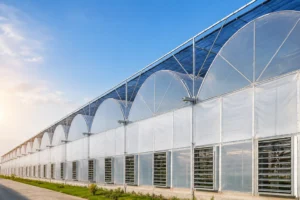
For EPC projects, the supplier should understand commercial-scale requirements such as span width, bay spacing, gutter height, column layout, wind exposure, crop clearance, equipment loads, and expansion planning.
A supplier that only provides standard greenhouse kits may not be suitable for larger projects where structural stability, installation sequence, documentation, and system compatibility are important.
Before selecting a greenhouse structure manufacturer, EPC teams should check whether the supplier can discuss:
For projects in Europe, EPC teams may also need to review greenhouse structure standards such as EN 13031-1 during early project evaluation.
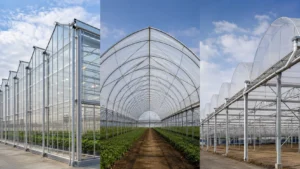
- multi-span greenhouse structures;
- gothic or arch frame options;
- roof ventilation and sidewall compatibility;
- galvanized steel frame specifications;
- wind load and local exposure conditions;
- foundation interface requirements;
- project-specific drawings and revisions;
- future expansion or repeated project phases.
The key question is not whether the supplier can sell a greenhouse. The key question is whether the supplier can support a commercial greenhouse structure as part of a real project delivery process.
Review Structural Drawings, BOM, Packing List, and Installation Documents
Documentation is one of the clearest ways to evaluate whether a greenhouse structure supplier is ready for EPC-level cooperation.
For commercial greenhouse projects, buyers should not rely only on product photos, catalog pages, or a simple quotation sheet. They should review whether the supplier can provide clear documents before production and shipment.
Important documents may include:
- structural drawings;
- member specifications;
- BOM or material list;
- packing list;
- installation manual or installation guidance;
- coating specification;
- container loading information;
- revision records when drawings or quantities change.
These documents help EPC teams, installers, and local integrators understand what will arrive on site and how the structure should be assembled.
If the BOM, packing list, and installation documents are unclear, the risk does not disappear. It moves to the installation site, where mistakes are more expensive to fix.
A reliable commercial greenhouse structure supplier should treat documentation as part of project control, not as an afterthought.
Add a Pre-Production Review Before Manufacturing
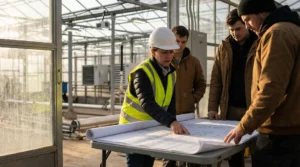
Before greenhouse structure manufacturing begins, EPC teams should complete a pre-production review with the supplier.
This review helps confirm that drawings, material specifications, coating requirements, packing logic, and project scope are aligned before steel members are produced. It is much easier to correct unclear details before production than after shipment.
A practical pre-production review may include:
- final layout and structural drawing confirmation;
- span, bay spacing, gutter height, and column layout review;
- member specifications and steel thickness confirmation;
- galvanized coating requirement confirmation;
- BOM and quantity check;
- packing sequence and bundle labeling plan;
- installation document availability;
- revision record confirmation;
- responsibility boundary between structure supply and local system integration.
For EPC projects, this step reduces avoidable mistakes before production starts. It also gives the local installer and integrator a clearer basis for site preparation, installation planning, and system coordination.
A supplier that supports pre-production review is usually easier to work with than a supplier that only confirms price and starts production quickly.
Confirm Galvanized Coating Options and Corrosion Exposure
For commercial greenhouse structures, galvanized coating should not be treated as a small material detail. It is part of the long-term structural protection strategy.
A reliable supplier should be able to explain available galvanized coating options and how they relate to the project environment. A dry inland project, a high-humidity greenhouse interior, and a coastal project may not require the same coating specification.
Before confirming an order, EPC teams should ask whether the supplier can discuss:
- galvanized steel frame specifications;
- coating options such as Z275, Z450, or Z600 when applicable;
- corrosion exposure in humid or coastal environments;
- areas with higher corrosion risk, such as gutters, column bases, and connection points;
- coating documentation before shipment;
- packing methods that reduce coating damage during transport.
The goal is not to select the highest coating grade for every project. The goal is to match the galvanized coating specification with the structure’s exposure environment, expected service life, and maintenance strategy.
For large commercial growers and project owners, this decision can affect long-term maintenance cost, structural confidence, and future expansion planning.
Evaluate Structure Compatibility With Local Integrators and EPC Teams
Many international greenhouse projects involve more than one company. The structure supplier may manufacture and export the greenhouse frame, while the local integrator or EPC team handles installation, ventilation, shading, irrigation, climate control, and site coordination.
This is why structure compatibility is important.
A suitable supplier should understand that the frame must support local system integration without taking over the integrator’s role. The supplier should provide a clear structure platform that allows local teams to coordinate system layout, equipment position, ventilation openings, shading support, and installation sequence.
Important compatibility points include:
- roof ventilation interface;
- sidewall ventilation and opening positions;
- shading system support points;
- gutter and drainage coordination;
- hanging load considerations;
- irrigation and pipe routing clearance;
- foundation and column layout;
- installation sequence for local contractors.
A clear structure-system boundary reduces confusion. The supplier should define what is included in the steel frame supply and what remains under the responsibility of the local integrator, EPC team, installer, or project owner.
This approach helps avoid one of the most common problems in greenhouse projects: unclear responsibility between structure supply and system integration.
Check Export Packaging, Shipment Logic, and Installation Support
For export greenhouse projects, supplier evaluation should also include packing, shipment, and installation support.
A commercial greenhouse structure may include many steel members, connectors, gutters, fasteners, and project-specific components. If these parts are not packed, labeled, and documented clearly, the installation team may lose time identifying materials on site.
A reliable supplier should provide export-ready packing logic that supports installation instead of only filling the container.
EPC teams should check whether the supplier can support:
- bundle labels for steel members;
- packing lists matched with the BOM;
- container loading records when required;
- separation of key connection parts;
- protection for galvanized surfaces during transport;
- installation manual or assembly guidance;
- communication before and after shipment;
- revision control when drawings or quantities change.
Good packing is not only a logistics issue. It is part of project execution control.
When the packing list, BOM, and installation documents are aligned, local contractors can identify parts faster, reduce mistakes, and keep the installation process closer to the project schedule.
Supplier Evaluation Checklist for EPC Teams
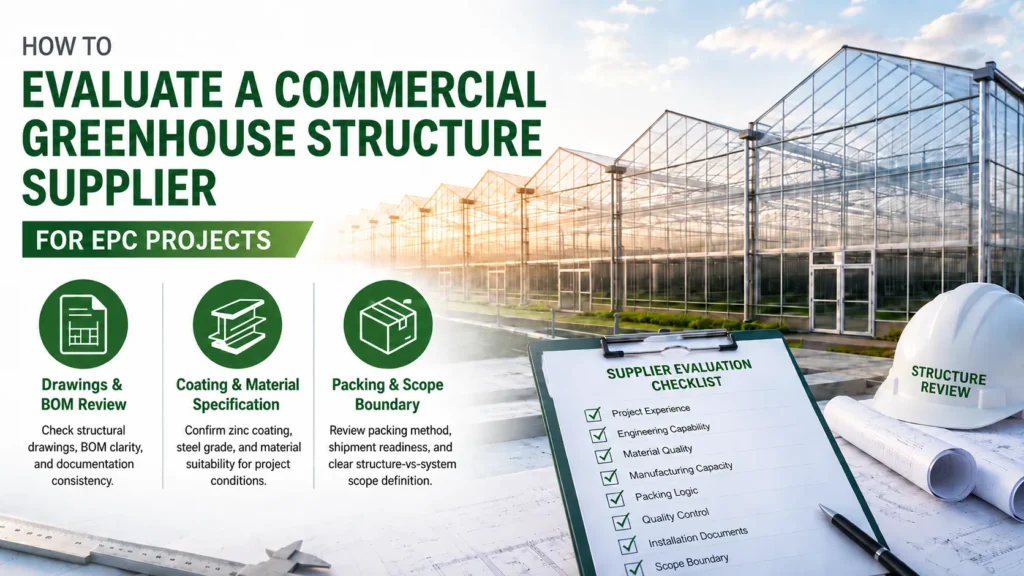
The following checklist can help EPC teams and integrators evaluate whether a commercial greenhouse structure supplier is suitable for project cooperation.
| Evaluation Point | What to Check | Why It Matters |
|---|---|---|
| Commercial greenhouse experience | Has the supplier worked with commercial-scale greenhouse structures? | Avoids mismatch with hobby or small garden greenhouse suppliers |
| Structure drawings | Can the supplier provide project-specific drawings, layout confirmation, and revision records? | Helps EPC teams verify dimensions, spans, and interfaces |
| Material specification | Are steel dimensions, member specifications, and coating options clearly defined? | Reduces procurement and production misunderstanding |
| Galvanized coating options | Can the supplier discuss Z275, Z450, Z600, or other coating requirements when applicable? | Supports corrosion protection planning |
| BOM and packing list | Are material quantities and packing details clearly documented? | Supports shipment verification and site installation |
| Pre-production review | Can the supplier confirm drawings, BOM, coating, packing, and revisions before manufacturing? | Reduces avoidable mistakes before production starts |
| Installation document support | Is an installation manual or assembly guidance available? | Helps local contractors reduce installation errors |
| Structure-system boundary | Is the supplier’s scope separated from local system integration? | Reduces responsibility disputes |
| Export experience | Can the supplier support container loading and export documentation? | Improves cross-border project execution |
| Communication process | Are drawing revisions, quotations, and project changes tracked clearly? | Reduces errors before production |
| Expansion suitability | Can the structure platform support future project phases? | Helps large growers and operators plan long-term investment |
Common Mistakes When Choosing a Greenhouse Structure Supplier
When EPC teams compare greenhouse structure suppliers, the lowest quotation is not always the safest choice. A cheaper structure may create hidden costs if drawings, coating specifications, packing logic, or installation documents are unclear.
Choosing Based Only on Price
A lower price may look attractive at the quotation stage, but missing documents, unclear specifications, or weak packing can increase costs during installation.
For commercial greenhouse projects, the better comparison is not only price. EPC teams should also compare drawings, coating options, documentation, delivery reliability, and project communication.
Treating All Greenhouse Suppliers as the Same
Not every greenhouse supplier is suitable for commercial EPC projects.
A supplier focused on hobby greenhouses, backyard greenhouses, or garden kits may not understand commercial structure requirements. EPC projects need stronger documentation, clearer scope, better packing, and more reliable coordination.
Ignoring Structure-System Boundaries
If the supplier’s scope is unclear, local integrators may face responsibility disputes during installation or system coordination.
A structure-first supplier should clearly define what is included in the steel frame supply and what remains under the responsibility of local integrators, installers, or EPC teams.
Not Checking Coating Specifications
The word “galvanized” is not enough.
Buyers should confirm the coating grade, project environment, corrosion exposure, and whether the coating specification matches the expected service life of the greenhouse structure.
Not Reviewing Packing Before Shipment
A packing list should not be created only after loading. It should support material verification, container checking, and installation planning.
When packing, BOM, and installation documents are not aligned, the installation team may spend extra time identifying parts on site. This can delay the project and increase avoidable communication costs.
A good supplier evaluation process should reduce these risks before production starts.
FAQ: Commercial Greenhouse Structure Supplier Selection
What is a commercial greenhouse structure supplier?
A commercial greenhouse structure supplier provides the steel frame, structural members, galvanized components, and related project documents for commercial greenhouse projects.
The supplier focuses on the structure platform rather than full local system integration. In many projects, the local integrator or EPC team remains responsible for ventilation, shading, irrigation, climate control, and installation coordination.
How do EPC teams evaluate a greenhouse structure supplier?
EPC teams should evaluate the supplier’s commercial project experience, structural drawings, coating specifications, BOM, packing list, installation support, export experience, and structure-system boundary clarity.
The goal is to confirm whether the supplier can support a real project delivery process, not only sell a greenhouse product.
What documents should a greenhouse structure supplier provide?
Important documents may include structural drawings, member specifications, BOM, packing list, installation manual, coating specification, container loading information, and revision records.
These documents help buyers verify materials before shipment and help local contractors understand the installation sequence.
What is a pre-production review for greenhouse structure manufacturing?
A pre-production review is a project check before manufacturing begins. It helps EPC teams and suppliers confirm drawings, member specifications, coating requirements, BOM, packing logic, and revision records before steel components are produced.
This step reduces the risk of production mistakes, shipment confusion, and installation delays.
What is the difference between a greenhouse structure supplier and a system integrator?
A greenhouse structure supplier provides the frame and structural documentation.
A system integrator usually handles ventilation, shading, irrigation, climate control, installation coordination, and local system integration.
Both roles are important, but the responsibility boundary should be clear before production and shipment.
Why is galvanized coating important when choosing a greenhouse structure supplier?
Galvanized coating affects corrosion protection and long-term maintenance.
EPC teams should confirm whether the coating specification matches the project environment, especially for humid or coastal greenhouse structures. The supplier should be able to discuss coating options and explain how the specification relates to project exposure and expected service life.
Should EPC teams choose the lowest-price greenhouse supplier?
Not necessarily.
A lower quotation may create hidden project risks if drawings, material specifications, coating options, packing logic, or installation documents are unclear. For EPC projects, supplier reliability and documentation quality can be as important as the initial price.
Can one greenhouse structure supplier support phased expansion projects?
Yes, if the supplier can provide a repeatable structure platform, consistent specifications, controlled drawings, and clear documentation for future phases.
This is especially important for large commercial growers and operators planning multi-stage greenhouse development. A repeatable frame platform can reduce design changes, simplify procurement, and help future greenhouse phases connect more cleanly with the original project.
¿Cómo elegir un proveedor de estructuras de invernadero para proyectos comerciales?
Para proyectos comerciales, los equipos EPC e integradores deben revisar la experiencia del proveedor, planos estructurales, especificaciones galvanizadas, BOM, lista de empaque, documentos de instalación y el límite entre suministro estructural e integración local.
Conclusion: Choose a Structure Partner, Not Only a Greenhouse Seller
Choosing a commercial greenhouse structure supplier is not only about finding a greenhouse seller with an attractive price.
For EPC teams, integrators, and engineering-led growers, the better goal is to find a structure partner who can support commercial-scale project requirements: drawings, specifications, coating options, BOM, packing list, installation documents, export coordination, pre-production review, and clear structure-system boundaries.
A reliable supplier should help reduce uncertainty before production and shipment. This is especially important for international greenhouse projects where the structure manufacturer, local installer, system integrator, and project owner may all work from different locations.
Before confirming a greenhouse structure order, EPC teams should ask a simple question:
Can this supplier support the project as a commercial greenhouse structure platform, or are they only selling a greenhouse product?
CHIYANG GREENHOUSE supplies commercial greenhouse structures with structure-first project support, galvanized coating options, and documentation assistance upon request.
Discuss Your Structural Requirements
Request Engineering Package