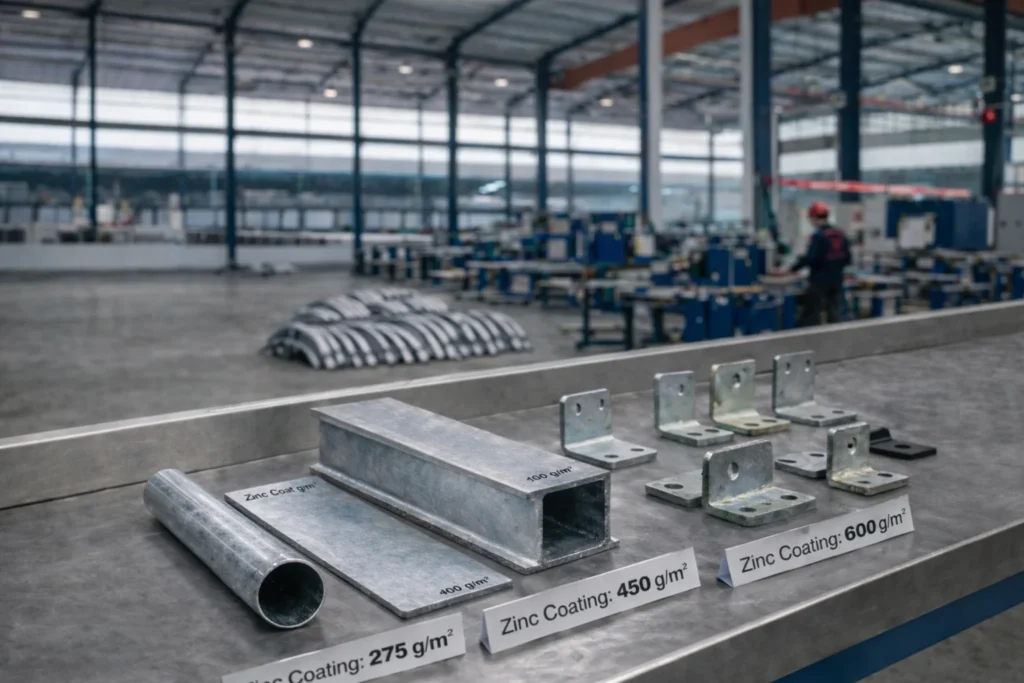
Z275 vs Z450 vs Z600 are common zinc coating options considered when specifying galvanized steel structures for commercial greenhouse projects.
In commercial greenhouse projects, zinc coating is often reduced to a simple price discussion. But in real project execution, coating choice affects corrosion risk, service life, maintenance planning, and long-term asset stability.
The right zinc specification is not just a materials question. It is a project decision tied to climate, location, lifespan, detailing, fabrication logic, and execution priorities.
If you have ever seen a greenhouse structure look fine at delivery but start showing corrosion earlier than expected, the issue was often not simply whether the steel was galvanized. The real issue was what that galvanizing specification actually meant, where the structure was installed, and which durability details were assumed to be standard.
This guide is written for greenhouse integrators, EPC teams, and engineering-led growers comparing greenhouse structures for real project deployment. It explains how to think about Z275, Z450, Z600, and project-based coating strategies in a practical way, not as abstract steel grades, but as corrosion-protection logic for commercial greenhouse structures.
Why zinc coating matters in commercial greenhouse structures
Comparing Z275 vs Z450 vs Z600 for Optimal Performance
Zinc coating is not a minor detail in greenhouse structure design. Commercial multi-span greenhouse structures are long-life steel assets expected to remain in service for many years under changing environmental conditions.
Corrosion does not only affect appearance. It affects service life, maintenance burden, inspection frequency, and the stability of the greenhouse as a long-term production platform. In commercial projects, replacing structural steel is far more disruptive and costly than replacing local accessories or secondary components. That is why coating choice should be treated as an early engineering and procurement decision, not a late-stage afterthought. Selecting the right galvanized structure supplier is also an important part of this process, because coating specifications, steel quality, and project documentation should be clearly defined before production begins. Learn more about how to evaluate a galvanized greenhouse structure supplier for commercial projects.
Greenhouse structures operate in a corrosion-relevant environment:
- persistent humidity and condensation cycles
- Repeated wet/dry exposure at connections and crevices
- localized exposure from fertilizers, disinfectants, or cleaning practices
- high connection density, including brackets, clips, fasteners, drilled holes, and cut ends
- areas that become difficult to inspect or recoat after the greenhouse is in operation
Zinc protects steel in two practical ways: as a barrier layer and through sacrificial protection. In simple project terms, coating selection is partly a decision about time: time before visible red rust appears, and time before the first maintenance intervention becomes unavoidable.
In many projects, the coating decision is locked too late, after quotation comparison has already pushed the conversation into price-only territory. That is usually when a durability decision starts being treated like a commodity line item.
What Z275, Z450, and Z600 actually mean
In practical terms, Z275, Z450, and Z600 refer to zinc coating mass designations for galvanized steel. The number represents the minimum total zinc coating mass on both sides combined, commonly expressed in grams per square meter.
For example:
- Z275 = 275 g/m² total coating mass
- Z450 = 450 g/m² total coating mass
- Z600 = 600 g/m² total coating mass
This prevents one common misunderstanding: Z275 is not 275 g/m² per side. It is a total-both-sides designation.
In general, higher coating mass means stronger corrosion-protection potential. But these values should not be treated as a shortcut for overall structural quality. A higher coating level does not automatically make one greenhouse structure better in every project. It simply means that the steel has a different level of zinc protection, which may or may not be appropriate depending on climate, exposure, service-life targets, detailing quality, and maintenance expectations.
There is also an important specification distinction to keep clear. Z275, Z450, and Z600 are coating designations commonly used for continuously coated galvanized steel products. In real greenhouse structures, durability also depends on product form, fabrication sequence, detailing, and the governing acceptance standard for the supplied component.
For project teams, the important point is this: coating selection should be linked to actual exposure conditions and project priorities, not only to nominal number comparison on a quotation sheet.
Why higher zinc is not the whole decision
A common mistake in commercial greenhouse procurement is to assume that higher zinc always solves the corrosion question. In reality, corrosion protection is influenced by much more than coating mass alone.
Project environment matters. Detailing matters. Drainage matters. Trapped moisture, cut edges, standing water, poor ventilation in connection zones, drilled holes, and execution quality can all affect long-term corrosion behavior. Even a higher zinc specification can lose practical value if the structure is poorly detailed or installed in a way that concentrates moisture and accelerates corrosion in local areas.
Atmospheric corrosivity classification methods such as ISO 9223 are commonly used as a reference when evaluating environmental factors that influence metal corrosion.
This is especially important in greenhouse structures, where many real corrosion problems are localized rather than uniform. Flat surfaces may remain acceptable while the first visible deterioration appears at:
- cut edges
- drilled holes
- fastener interfaces
- bracket connections
- lap joints and crevices
- gutter and base areas where water remains longer
That is why coating selection should be treated as part of a broader corrosion strategy. In some cases, a lower coating in the right environment with good detailing and drainage may outperform a poorly executed higher-spec option in a more aggressive environment.
Matching zinc coating to project environment
The right zinc specification depends on where and how the greenhouse structure will actually operate.
Different environments require different considerations, including humidity, rainfall, coastal exposure, and fertilizer-related corrosion risks. For a more detailed guide, see our article on selecting Z275, Z450, or Z600 for inland, humid, and coastal greenhouse projects.
Inland, dry, or lower-corrosion environments
In inland or relatively dry environments with lower corrosion exposure, Z275 or another project-appropriate standard coating may be acceptable depending on target service life, budget logic, and maintenance expectations.
For these projects, the key question is not whether the coating is the highest possible, but whether it is properly aligned with the actual operating environment and the owner’s durability expectations.
Typical focus points include:
- avoiding trapped moisture at connections
- confirming fastener compatibility
- treating cut ends and drilled holes as first-class durability details
- making sure drainage and drying behavior are not ignored simply because the site is not coastal
Humid, agricultural, or year-round commercial environments
In more humid agricultural environments, or in projects expected to run year-round with high operational intensity, higher coating levels such as Z450 often become more reasonable.
Where long service life, lower maintenance disruption, and better long-term protection are priorities, moving beyond minimum coating logic can be justified.
This is also the type of environment where condensation management starts to matter as much as nominal coating class. Repeated wet/dry cycles at clips, brackets, tube interfaces, and shaded areas can materially affect corrosion behavior even if the site is not classified as coastal.
Coastal, salt-influenced, or clearly corrosive environments
For coastal areas, salt-influenced regions, or other clearly corrosive environments, Z600 or a stronger project-based anti-corrosion strategy may be more appropriate.
In these conditions, corrosion exposure is materially higher, and the structure may require a stronger protection strategy to support long-term project durability. In practice, coastal environments are often where Z450 becomes the starting conversation rather than the upgrade option, and where Z600 becomes easier to justify if the structure is expected to serve as a long-life production asset.
The key is not to treat all projects the same. Zinc coating should be matched to environmental exposure, structural service-life expectations, and the owner’s real operating priorities.
Zinc coating is also a lifecycle decision
Coating selection is not only about corrosion resistance at delivery. It is also a lifecycle decision.
Short-term procurement thinking often undervalues corrosion protection because the immediate comparison is focused on upfront cost. But for commercial greenhouse projects, the structure is part of a long-term production asset. It supports crop continuity, maintenance planning, operational predictability, and future expansion.
A better-aligned coating strategy can reduce maintenance disruption, improve long-term asset stability, and help the structure remain reliable across multiple production cycles. In some markets, long-life structural durability also affects how a greenhouse project is viewed from a financing, insurance, or phased-expansion perspective.
This is one reason many experienced project teams no longer ask only, “What is the zinc class?” They also ask, “What is the expected time to first maintenance under this environment and detailing logic?”
That is a more useful project question. It shifts the discussion from number comparison to service-life planning.
Why the highest zinc coating is not always the right answer
There are several reasons “maximize Z” can be a poor specification even when the project budget allows it.
1. Details can dominate performance
If cut edges, drilled holes, welded areas, and connection interfaces are not handled correctly, they can become the first failure locations regardless of coating mass on flat surfaces.
2. Not all corrosion exposure is uniform
Many greenhouse corrosion issues are localized: around gutters, at base connections, at wet crevices, or near chemical-handling zones. In those cases, a targeted detail strategy may outperform a blanket highest-coating-everywhere approach.
3. Coating choice should match maintenance reality
If the greenhouse is designed so that inspection and touch-up are realistic, project teams can make different coating decisions than if the greenhouse is a high-utilization asset with limited downtime.
4. Product form and fabrication sequence matter
Durability outcomes also depend on what happens after the coating class is selected, including cutting, drilling, welding, field modifications, repair logic, storage, and installation realities. The goal is not to force one process, but to ensure that the chosen coating class still makes sense after fabrication and execution are considered.
What integrators and EPC teams should confirm before locking the coating specification?
Before finalizing zinc coating requirements, project teams should confirm the basic conditions that affect corrosion exposure, lifecycle expectations, and specification discipline.
A practical checklist includes:
- project location
- distance from the coast or other salt exposure sources
- humidity level and local agricultural operating conditions
- irrigation, cleaning, drainage, and moisture-retention conditions around the structure
- whether the structure is rain-washed, sheltered, or exposed differently across different zones
- target service life of the greenhouse project
- maintenance expectations and maintenance access logic
- export, packing, storage, and installation timing
- whether structural detailing and drainage design are aligned with the corrosion strategy
- whether the owner is comparing based only on the upfront price or on the lifecycle value
- whether cut edges, drilled holes, field modifications, fastener interfaces, and welded areas are addressed clearly in the specification
- which coating class is being specified, how it is measured, and which standard governs acceptance
If these inputs are unclear, it becomes difficult to justify one coating strategy over another in a disciplined way.
Where CHIYANG GREENHOUSE fits
For role clarity in commercial greenhouse projects, CHIYANG GREENHOUSE supplies commercial greenhouse structures together with engineering documentation to support procurement, execution, and long-term durability planning.
Our role is structured supply, not turnkey greenhouse delivery. Climate systems, irrigation, fertigation, shading, automation, and full system integration are typically handled by local integrators or EPC teams according to project requirements and regional execution practice.
When corrosion exposure is unclear, the most useful next step is usually to confirm the project environment, service-life expectations, maintenance priorities, and structural detail strategy before finalizing the coating specification.
Conclusion
Z275, Z450, and Z600 are useful specification references, but they should never be treated as isolated numbers.
For commercial greenhouse structures, the right coating decision depends on:
- the actual exposure environment
- the expected service life and maintenance model
- the details that control where corrosion starts first
- the fabrication, storage, and installation reality of the project
- the owner’s real operating priorities and long-term asset logic
A better zinc coating decision is not simply “choose the highest coating.” It is:
- Define the real corrosion environment
- Match the coating class to that exposure
- Address weak points such as edges, holes, joints, fasteners, and crevices
- Align the specification with fabrication sequence, detailing, and maintenance reality
- Evaluate the decision as part of lifecycle value, not only upfront quotation comparison
That is the approach most likely to produce a greenhouse structure that performs the way the project team expects in the real operating environment.
FAQ
What is the practical difference between Z275, Z450, and Z600 in greenhouse structures?
The practical difference is the level of zinc coating mass used for corrosion protection. Higher coating mass generally means stronger corrosion-protection potential, but the right choice depends on the project environment, service-life target, detailing quality, and execution conditions.
1) Is Z600 always the best choice for commercial greenhouse projects?
No. Z600 is not automatically the best choice for every project. In some environments, it may be justified, especially where corrosion exposure is high, but coating selection should follow project conditions rather than simple number comparison.
2) When should a greenhouse project consider higher coating protection?
Projects in humid, year-round, coastal, salt-influenced, or otherwise corrosive environments should evaluate higher coating protection more seriously, especially when long service life and reduced maintenance are priorities.
3) What project information should be confirmed before selecting zinc coating?
At minimum, confirm the project location, distance from the coast, humidity and irrigation conditions, drainage logic, target service life, maintenance expectations, fabrication and installation realities, and whether the project is being evaluated on upfront price or lifecycle value.
4) Does coating choice affect only corrosion, or also long-term project value?
It affects both. Coating choice influences corrosion risk, maintenance planning, structural durability, and in some cases the long-term asset value, financing logic, and phased-expansion reliability of the project.
5) What does “time to first maintenance” mean in practical terms?
In practical terms, it refers to the expected period before the galvanized surface reaches the point where maintenance becomes necessary under actual environmental exposure. It is usually a more useful way to discuss durability than asking for a generic “years guaranteed” statement without defining assumptions.
6) Does CHIYANG GREENHOUSE provide turnkey greenhouse systems?
No. CHIYANG GREENHOUSE provides structural supply and engineering documentation. Local integrators or EPC partners typically handle climate systems, irrigation, shading, automation, and system integration.