Introduction
Selecting a greenhouse frame type is not only a matter of appearance, budget, or product preference.
For commercial greenhouse projects, the frame structure affects how the project handles wind loads, supports covering materials, coordinates with ventilation and shading systems, drains rainwater, allows maintenance access, and expands in future phases.
This guide compares Venlo vs Gothic vs multi-span greenhouse structures from the perspective of commercial project selection, not only product appearance.
EPC teams, greenhouse integrators, and engineering-led growers should not ask only:
“Which greenhouse type is best?”
A better question is:
“Which greenhouse frame type fits the project environment, covering material, system interface, and long-term operation plan?”
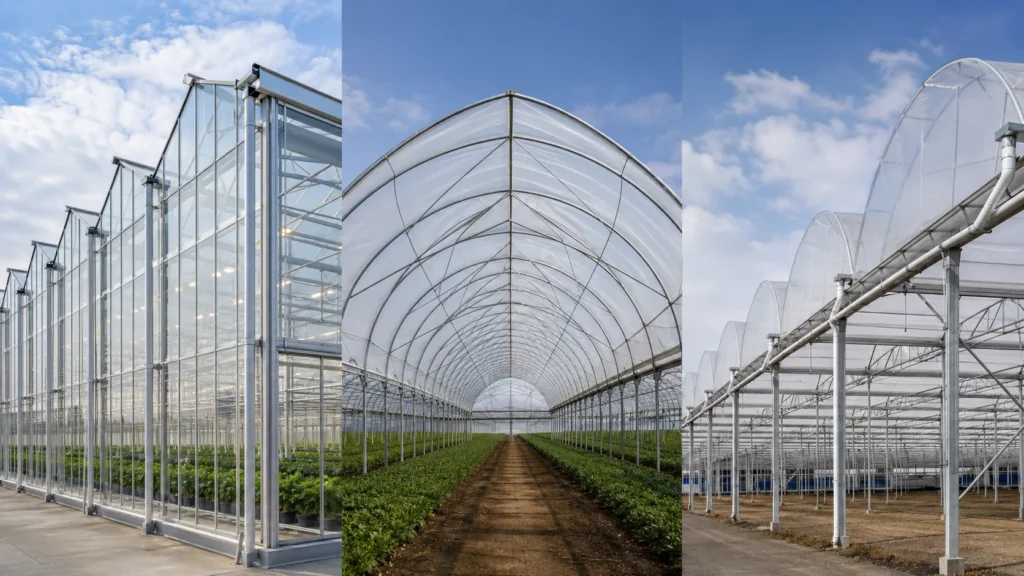
Venlo, Gothic, and multi-span greenhouse structures each serve different project conditions. The right choice depends on climate exposure, span requirements, covering material, internal clearance, system compatibility, execution complexity, and future expansion strategy.
This article compares Venlo, Gothic, and multi-span greenhouse structures from a structure-first perspective for commercial greenhouse projects.
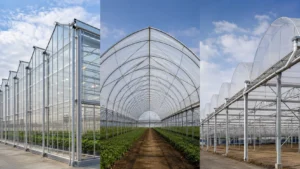
Quick Selection Summary: Which Greenhouse Frame Type Fits Your Project?
For most commercial greenhouse projects, the frame type should be selected according to covering material, climate exposure, span requirements, system interface, and future expansion planning.
| Project Condition | More Suitable Frame Type |
|---|---|
| Large-scale commercial film greenhouse with phased expansion | Multi-Span Greenhouse |
| Commercial project requiring flexible layout and cost control | Multi-Span Greenhouse |
| Rain, snow, condensation, or roof runoff-sensitive project | Gothic Greenhouse |
| Project requiring curved roof geometry and useful internal clearance | Gothic Greenhouse |
| High-spec glasshouse or rigid-cover greenhouse project | Venlo Greenhouse |
| Controlled-environment project requiring precise system coordination | Venlo Greenhouse |
| EPC / integrator-led project with adaptable local systems | Multi-Span or Gothic, depending on climate |
| Long-term high-investment project with strict execution control | Venlo Greenhouse |
Direct answer:
For large commercial film greenhouse projects, a multi-span greenhouse is often the most flexible option. For sites where roof geometry helps with rain, snow, condensation, or internal clearance, a Gothic greenhouse may be more suitable. For high-spec glass or rigid-cover projects, a Venlo greenhouse is usually the better fit because it supports more precise structure and system coordination.
The final choice should not be based only on price or appearance. EPC teams and greenhouse integrators should evaluate the frame type together with climate exposure, covering material, system interface, documentation requirements, and future expansion plans.
Why Frame Type Selection Matters in Commercial Greenhouse Projects
In commercial greenhouse projects, frame type is a structural decision, not only a product style.
The selected frame affects:
- how wind and vertical loads are transferred;
- how the roof drains rainwater or sheds snow;
- how the covering material is supported;
- how gutters, columns, purlins, and bracing are arranged;
- how ventilation, shading, irrigation, and climate systems interface with the structure;
- how easily the greenhouse can be installed, maintained, repaired, or expanded.
A wrong frame choice may not always fail immediately, but it can create problems during execution or long-term operation.
For example, a frame selected only for its lower initial price may later require more site adjustment, more complex system coordination, or higher maintenance work. A structure copied from another region may not match local wind exposure, rainfall intensity, snow conditions, humidity, or corrosion risk.
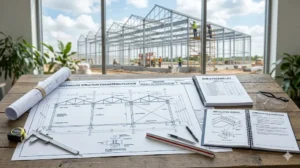
For EPC teams and integrators, frame type should be evaluated before confirming drawings, BOM, coating specifications, packing logic, and installation documents.
Answer snippet:
In commercial greenhouse projects, frame type is a structural decision. It influences how the greenhouse handles loads, supports covering materials, coordinates with systems, drains water, and expands over future project phases.
What Is a Multi-Span Greenhouse Structure?
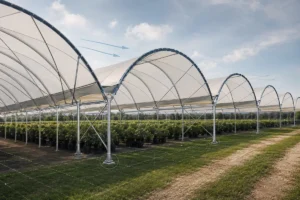
A multi-span greenhouse structure is a connected greenhouse frame system made of multiple bays or spans. Instead of using isolated single tunnels, the structure connects repeated roof and column modules to form a larger commercial growing area.
Multi-span structures are widely used in commercial greenhouse projects because they provide a practical balance between scale, flexibility, cost control, and system adaptability.
They are commonly associated with film-covered or flexible covering systems, but the exact design depends on project requirements, local climate, span, height, gutter arrangement, and system interface.
Typical Project Conditions for Multi-Span Greenhouse Structures
Multi-span greenhouse structures are often considered for:
- large-scale commercial vegetable production;
- multi-phase expansion projects;
- projects that need repeatable structure platforms;
- cost-sensitive commercial greenhouse investment;
- projects requiring adaptable interfaces with local ventilation, shading, irrigation, or climate systems;
- integrator-led or EPC-led projects where structural flexibility is important.
For large growers or operators, a multi-span platform can also support future replication. If the first project phase performs well, the same frame logic may be repeated in later phases or other production sites.
Engineering Considerations for Multi-Span Greenhouses
When evaluating a multi-span greenhouse structure, the main engineering considerations include:
- span width and column layout;
- gutter load transfer;
- drainage direction and rainfall intensity;
- wind load resistance;
- bracing arrangement;
- covering tension and replacement;
- maintenance access;
- compatibility with ventilation, shade, irrigation, and crop support systems.
Because multi-span greenhouses usually cover large areas, small structural decisions can affect the whole project. Column spacing, gutter logic, roof slope, and bracing layout should be reviewed as part of the project design basis.
For EPC teams, a multi-span greenhouse is not simply a large greenhouse. It is a repeatable structural platform that must coordinate with site conditions, covering material, system layout, and future expansion plans.
What Is a Gothic Greenhouse Structure?
A Gothic greenhouse structure uses a curved or pointed arch roof profile. Compared with flatter roof shapes, the Gothic geometry can support better roof runoff and may help reduce accumulation of rainwater, condensation, or snow depending on the design and local climate.
Gothic structures are often used in commercial projects where roof geometry matters. The curved roof profile can provide useful internal height, improve drainage behavior, and support film-covered greenhouse applications.
However, Gothic does not automatically mean stronger or better in every situation. Its value depends on whether the roof shape matches the project’s climate exposure, covering system, span, and installation requirements.
Typical Project Conditions for Gothic Greenhouse Structures
Gothic greenhouse structures may be considered for:
- commercial projects in rain-exposed areas;
- sites where snow shedding is a design concern;
- projects requiring better roof runoff than flatter profiles;
- film-covered commercial greenhouse structures;
- projects where internal clearance and roof height are important;
- applications where curved roof geometry supports better condensation or drainage management.
For some engineering-led growers, the Gothic profile can offer a practical balance between commercial growing space and roof performance.
Engineering Considerations for Gothic Greenhouses
When evaluating a Gothic greenhouse structure, EPC teams should review:
- arch geometry;
- roof curvature;
- connection points;
- covering tension;
- wind exposure;
- snow or rainfall conditions;
- gutter and drainage logic;
- installation sequence;
- compatibility with roof vents, shading, and other systems.
The curved roof profile can be useful, but it also requires careful detailing. Covering material must be properly tensioned and fixed. Connection points must be coordinated with the frame geometry. If local systems are added, the interface between the structure and those systems should be clarified before production.
For climate-exposed sites, Gothic geometry may reduce roof accumulation risk, but the final performance still depends on span, bracing, covering fixation, gutter design, and local load assumptions. EPC teams should review these factors before selecting a Gothic greenhouse structure for commercial projects.
A Gothic greenhouse should be selected because its geometry fits the project conditions, not only because the shape looks more advanced.
What Is a Venlo Greenhouse Structure?
A Venlo greenhouse structure is a modular greenhouse frame type often associated with glasshouses or rigid-cover greenhouse projects. It usually uses repeated roof bays, precise structural modules, and more detailed coordination between the frame, covering, ventilation, gutter, and climate systems.
Venlo greenhouses are often selected for high-spec commercial projects where light transmission, environmental control, long-term operation, and rigid covering performance are important.
Compared with film-covered multi-span or Gothic structures, Venlo projects usually require tighter engineering coordination and more detailed execution control.
Typical Project Conditions for Venlo Greenhouse Structures
Venlo greenhouse structures may be suitable for:
- high-spec commercial greenhouse projects;
- glasshouse projects;
- rigid-cover greenhouse structures;
- controlled-environment agriculture projects;
- long-term production operations with higher investment levels;
- projects requiring precise coordination between structure and systems;
- projects where environmental performance and long-term operation are key priorities.
Venlo structures are not usually selected only because of appearance. They are selected when the project requires a higher level of structural precision, covering support, ventilation coordination, and engineering documentation.
Engineering Considerations for Venlo Greenhouses
When evaluating a Venlo greenhouse structure, EPC teams should pay attention to:
- glass or rigid covering loads;
- roof bay module;
- gutter design;
- condensation management;
- ventilation interface;
- structural tolerance;
- support points for rigid panels;
- installation accuracy;
- engineering drawings and documentation;
- coordination with local system integrators.
Venlo greenhouse structures usually have higher execution complexity. The structure, covering, and system interface should be reviewed together before production.
For this reason, Venlo is often more suitable for projects with clear engineering requirements, stronger project management capacity, and experienced local integration partners.
Comparison Table: Venlo vs Gothic vs Multi-Span Greenhouse Structures
The table below compares Venlo, Gothic, and multi-span greenhouse structures from a commercial project selection perspective. It is intended for EPC teams, greenhouse integrators, and engineering-led growers who need to evaluate frame types based on covering material, climate exposure, structure cost, system compatibility, expansion potential, and execution complexity.
| Evaluation Point | Multi-Span Greenhouse | Gothic Greenhouse | Venlo Greenhouse |
|---|---|---|---|
| Typical covering | Film or flexible covering | Film, some rigid options | Glass or rigid panels |
| Project scale | Large commercial growing | Commercial and climate-exposed projects | High-spec commercial projects |
| Structure cost | Usually more flexible | Medium | Higher |
| Climate suitability | Broad, depending on design | Strong for rain or snow shedding | Strong for controlled environments |
| System compatibility | Strong | Strong | Very strong, but more complex |
| Expansion suitability | Strong | Medium to strong | Project-specific |
| Engineering complexity | Moderate | Moderate | Higher |
| Maintenance access | Usually practical | Practical, depending on design | Requires detailed planning |
| Best fit | Large-scale adaptable projects | Curved-roof climate conditions | High-spec rigid-cover projects |
Summary:
Multi-span structures are often selected for flexible commercial production and phased expansion. Gothic frames are useful where roof geometry helps with rain, snow, condensation, or internal clearance. Venlo structures are more suitable for high-spec rigid-cover projects that require tighter engineering coordination.
The best frame type is not the one that looks most advanced. It is the one that fits the project’s climate, covering material, structural span, system interface, execution capacity, and lifecycle plan.
How Climate, Wind, and Snow Affect Greenhouse Frame Selection
Climate exposure is one of the most important factors in greenhouse structure selection.
A greenhouse frame that works well in one region may not perform the same way in another. EPC teams should evaluate wind exposure, rainfall, snow, humidity, temperature variation, and corrosion risk before selecting Venlo, Gothic, or multi-span greenhouse structures.
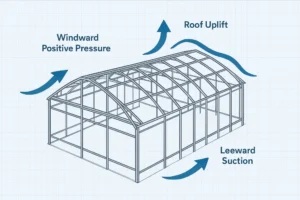
Wind load affects:
- frame spacing;
- column layout;
- bracing design;
- roof height;
- connection strength;
- foundation coordination;
- covering fixation.
Rainfall and snow conditions affect:
- roof geometry;
- gutter capacity;
- drainage direction;
- roof slope;
- maintenance access;
- risk of local accumulation.
High-humidity or coastal environments may also affect coating selection. In these cases, the frame type and coating option should be reviewed together, especially for long-term commercial operation.
A frame type should not be copied from another climate without structural review. For local structural requirements, EPC teams should also review applicable greenhouse design standards, such as EN 13031-1 where relevant.EPC teams and integrators should confirm the project location, local exposure, design assumptions, and documentation requirements before finalising the structure type.
For related structural design topics, see CHIYANG GREENHOUSE insights on Wind Load Greenhouse Structure Design, Wind, Span, and Climate Considerations, Greenhouse Gutter Load Transfer, and Zinc Coating Options for Greenhouse Structures.
Answer snippet:
A greenhouse frame that works well in one climate may not be suitable for another. EPC teams should evaluate wind exposure, rainfall, snow, humidity, and corrosion risk before selecting Venlo, Gothic, or multi-span structures.
How Covering Materials Affect Frame Type Decisions
Covering material is not separate from structure selection.
Film, polycarbonate, and glass place different requirements on the greenhouse frame. The structure must support the selected covering material safely and practically during installation, operation, maintenance, and replacement.
Film-covered greenhouse structures usually require attention to:
- film tension;
- fixing points;
- replacement access;
- wind behavior;
- roof shape;
- purlin and arch arrangement.
Polycarbonate greenhouse structures may require attention to:
- panel support;
- fixing method;
- expansion and contraction;
- panel width;
- frame tolerance;
- edge protection.
Glass or rigid-cover greenhouse structures usually require attention to:
- structural tolerance;
- support points;
- load transfer;
- gutter and condensation logic;
- installation precision;
- maintenance access;
- higher documentation requirements.
This is why a greenhouse frame should not be selected before confirming the covering strategy. The covering material affects span, purlin spacing, roof geometry, load assumptions, and system interface.
For example, a multi-span film greenhouse may be a practical option for a large commercial vegetable project with phased expansion. A Gothic structure may be useful where curved roof geometry improves runoff or internal clearance. A Venlo structure may be more suitable for a high-spec rigid-cover project requiring precise engineering coordination.
The correct choice depends on how the covering material, frame geometry, climate exposure, and project execution plan work together.
Which Frame Type Is Better for EPC and Integrator-Led Projects?
For EPC teams and greenhouse integrators, the best frame type depends on project conditions.
There is no universal answer.
Multi-Span Greenhouse: Flexible for Large Commercial Projects
Multi-span greenhouse structures are often a strong choice for large commercial projects that require flexible layout, phased expansion, and practical cost control.
They can be suitable when the project needs:
- large production area;
- repeatable structure platform;
- adaptable system interface;
- practical maintenance access;
- future expansion;
- balanced investment and performance.
For integrator-led projects, multi-span structures can provide a flexible frame platform while allowing local partners to coordinate ventilation, shading, irrigation, automation, and other systems.
Gothic Greenhouse: Useful Where Roof Geometry Matters
Gothic greenhouse structures are useful when roof geometry is part of the engineering decision.
They may be considered when the project requires:
- better roof runoff;
- improved snow or rain shedding;
- useful internal clearance;
- curved roof profile;
- film-covered commercial structure;
- climate-exposed project conditions.
For EPC teams, the Gothic frame should be selected because the roof profile supports the site conditions, not only because it has a recognizable shape.
Venlo Greenhouse: Suitable for High-Spec Rigid-Cover Projects
Venlo greenhouse structures are generally more suitable for high-spec commercial projects using glass or rigid covering systems.
They may be considered when the project requires:
- rigid covering support;
- precise modular structure;
- detailed ventilation coordination;
- long-term controlled-environment operation;
- stronger documentation control;
- experienced engineering and installation coordination.
Venlo structures often require more planning before production. They are not usually the simplest option, but they can be appropriate when the project’s investment level, operation strategy, and system requirements justify the higher engineering complexity.
Buyer Questions Before Selecting a Greenhouse Frame Type
Before selecting Venlo, Gothic, or multi-span greenhouse structures, EPC teams and integrators should clarify several key questions:
- What covering material will be used?
- What climate exposure must the structure handle?
- What wind, rain, snow, humidity, or corrosion risks exist at the site?
- What span and height are required?
- Will the project expand in future phases?
- What local systems need to interface with the frame?
- Who is responsible for local system integration?
- What drawings and documents are required before production?
- What installation sequence is expected?
- What maintenance access is needed after operation begins?
These questions help move the discussion away from simple product comparison and toward project-specific structural selection.
For commercial projects, the greenhouse frame should be selected as part of the project design basis.
Common Mistakes When Comparing Greenhouse Frame Types
Choosing Based Only on Appearance
A greenhouse may look modern, strong, or attractive, but the visual shape does not explain whether it fits the project load, covering material, climate exposure, or system requirements.
Frame geometry should be evaluated against project conditions, not only marketing images.
Comparing Prices Before Confirming Structure Scope
Different frame types may include different steel quantities, gutter designs, covering supports, bracing logic, connection details, coating requirements, and documentation levels.
A lower initial structure price may not mean lower total project cost if installation, system coordination, maintenance, or future expansion become more difficult.
Ignoring Local Climate Exposure
A frame selected for one region may not work the same way in another region.
Wind, rain, snow, humidity, and corrosion risk should be reviewed before choosing the structure type.
Treating Covering Materials as Separate from Structure
Covering material affects load, purlin spacing, support points, roof geometry, replacement access, and maintenance strategy.
Film, polycarbonate, and glass require different structural support logic.
Forgetting Future Expansion
Many commercial greenhouse projects are built in phases. Large growers and operators should evaluate whether the selected frame platform can be repeated, extended, or adapted in later phases.
A structure that works for one phase may not always be the best platform for long-term expansion.
Overlooking the Structure-System Boundary
The greenhouse frame must coordinate with ventilation, shading, irrigation, climate control, and other systems. However, structure supply and local system integration are not the same responsibility.
EPC teams should clarify which party supplies the frame, which party integrates local systems, and what interface information is required before production.
Selection Checklist for EPC Teams
The checklist below helps EPC teams and greenhouse integrators select the right greenhouse frame type before confirming production drawings, BOM, coating specifications, packing list, and installation documents. It can be used to compare Venlo, Gothic, and multi-span greenhouse structures based on project conditions rather than product appearance alone.
| Question | Why It Matters |
|---|---|
| What covering material will be used? | Film, glass, and polycarbonate require different frame support logic. |
| What climate exposure will the structure face? | Wind, snow, rain, humidity, and corrosion affect frame selection. |
| What span and height are required? | Crop clearance, equipment, and airflow depend on structural geometry. |
| Will the project expand later? | Multi-phase projects need repeatable structure platforms. |
| Which systems need to interface with the frame? | Ventilation, shading, irrigation, and climate systems need clear structure interfaces. |
| What documents are needed before production? | Drawings, BOM, coating specs, packing list, and installation documents reduce execution risk. |
| Who handles local system integration? | The boundary between structure supply and local integration must be clear. |
This checklist can help EPC teams, greenhouse integrators, and engineering-led growers compare frame types based on project requirements instead of generic product preference.
FAQ: Venlo, Gothic, and Multi-Span Greenhouse Structures
What is the main difference between Venlo, Gothic, and multi-span greenhouse structures?
The main difference is the frame geometry, covering material compatibility, engineering complexity, and project fit. Multi-span greenhouses are flexible platforms for large commercial production and phased expansion. Gothic greenhouses use curved roof geometry that can help with rain, snow, condensation, or internal clearance. Venlo greenhouses are usually used for high-spec glass or rigid-cover projects that require precise engineering coordination.
Which greenhouse structure is best for commercial projects?
There is no single best greenhouse structure for every commercial project. Multi-span greenhouses are often suitable for large commercial film projects. Gothic greenhouses may fit climate-exposed sites where roof geometry matters. Venlo greenhouses are more suitable for high-spec rigid-cover or glasshouse projects.
Is a multi-span greenhouse suitable for EPC projects?
Yes. A multi-span greenhouse is often suitable for EPC-led commercial projects because it can support large production areas, system coordination, phased expansion, and repeatable project design. It is commonly used when flexibility, scale, and practical cost control are important.
When should a Gothic greenhouse structure be considered?
A Gothic greenhouse structure should be considered when curved roof geometry is useful for rain runoff, snow shedding, condensation behavior, or internal clearance. It can be a practical option for film-covered commercial projects in climate-exposed locations.
When is a Venlo greenhouse structure suitable?
A Venlo greenhouse structure is suitable for high-spec commercial projects using glass or rigid covering systems. It is often selected when the project requires precise structural tolerance, ventilation coordination, gutter design, and long-term controlled-environment operation.
How do covering materials affect greenhouse frame selection?
Covering materials affect frame selection because film, polycarbonate, and glass require different support logic. Film structures need attention to tension and replacement access. Polycarbonate panels require support and fixing details. Glass or rigid panels require tighter structural tolerance and stronger support coordination.
How does climate affect greenhouse frame selection?
Climate affects greenhouse frame selection through wind load, rainfall, snow, humidity, and corrosion risk. Wind exposure can influence bracing, frame spacing, and connection design. Rain and snow can influence roof geometry and drainage. Humidity and coastal exposure may influence coating selection.
Can one greenhouse supplier provide different frame types?
Yes, one supplier may provide different greenhouse frame types, but EPC teams should confirm whether the supplier can provide the correct drawings, structure specifications, coating options, BOM, packing list, installation documents, and structure-system boundary for each frame type.
Should greenhouse frame type be selected before or after choosing covering material?
Frame type and covering material should be evaluated together. The covering material affects span, purlin spacing, support points, roof geometry, installation tolerance, and maintenance strategy.
Why is the structure-system boundary important?
The structure-system boundary is important because the greenhouse frame must interface with ventilation, shading, irrigation, climate control, and automation systems. However, structure supply is different from local system integration. EPC teams should clarify which party handles each scope before production.
Conclusion
Frame type selection should not be treated as a simple product preference.
For EPC teams, greenhouse integrators, and engineering-led growers, the choice between Venlo, Gothic, and multi-span greenhouse structures should be based on project environment, covering material, structural span, system interface, expansion strategy, and lifecycle requirements.
Multi-span structures are often practical for large-scale commercial production and phased expansion. Gothic frames can be useful where roof geometry supports better rain, snow, condensation, or internal clearance performance. Venlo structures are more suitable for high-spec rigid-cover projects that require tighter engineering coordination.
CHIYANG GREENHOUSE supplies commercial greenhouse structures with structure-first project support, coating option discussion, and documentation assistance upon request. Local system selection, installation, and integration should be coordinated by the project’s EPC team, greenhouse integrator, or local project partner.
Discuss Your Structural Requirements
Share your project location, covering material, greenhouse size, and expected structure type with CHIYANG GREENHOUSE.
Request Engineering Package
For qualified commercial projects, drawings, BOM, coating discussion, packing list, and installation documentation can be discussed upon request.