A reliable commercial greenhouse structure quotation cannot be prepared based on project area alone.
Many greenhouse buyers start an inquiry with a simple question:
“How much does a greenhouse structure cost per square meter?”
For standard products, this may provide a rough reference. However, commercial greenhouse projects involve multiple engineering variables that directly influence structural design, material selection, manufacturing scope and final quotation accuracy.
Before preparing a professional greenhouse structure quotation, a supplier normally needs to understand:
- Project location and climate conditions
- Greenhouse dimensions and structural layout
- Greenhouse type and structural form
- Covering material and fixing system
- Wind load and snow load requirements
- Corrosion protection requirements
- Project stage and delivery scope
At CHIYANG GREENHOUSE, we focus on structure-first commercial greenhouse supply.
Our role is to support commercial greenhouse projects with galvanized steel structures, structure-related BOM, manufacturing coordination, packing solutions and engineering document communication.
A complete quotation starts with complete project information.
Quick Information Checklist Before Requesting a Greenhouse Structure Quote
Before contacting a greenhouse structure supplier, preparing the following information can significantly improve quotation accuracy.
| Required Information | Why It Matters |
|---|---|
| Project location | Determines climate and corrosion conditions |
| Greenhouse area and dimensions | Defines structural layout |
| Greenhouse type | Affects frame design |
| Covering material | Influences fixing and load transfer |
| Wind load and snow load | Determines structural requirements |
| Corrosion environment | Determines coating requirements |
| Project stage | Defines quotation accuracy |
| Delivery destination | Defines packing and export scope |
The more complete the project inputs are, the more reliable the greenhouse structure quotation can become.
Why a Greenhouse Structure Quote Cannot Be Based on Area Alone
A commercial greenhouse is not simply a square-meter product.
Two greenhouse projects with the same area may require completely different structural solutions.
For example, a 10,000 m² greenhouse project in a mild inland climate may require a different structure compared with a 10,000 m² greenhouse located in:
- A coastal area with higher corrosion exposure
- A cold region with heavy snow
- A high-wind location
- An area requiring extended service life
The quotation depends on multiple engineering inputs, including:
- Steel quantity
- Structural span
- Column arrangement
- Arch or truss design
- Connection details
- Galvanization requirements
- Packing method
- Installation considerations
This is why professional greenhouse structure suppliers usually review project information before providing a final quotation.
A preliminary budget estimate can be prepared with limited information, but a reliable structure quotation requires a clearer project definition.
1. Project Location and Climate Conditions
Project location is one of the first inputs required for commercial greenhouse structure quotation.
The same greenhouse design may require different structural considerations depending on where it will be installed.
Important location information includes:
Country and Region
The country and region help suppliers understand:
- Climate conditions
- Common greenhouse systems
- Possible design references
- Export requirements
Wind Conditions
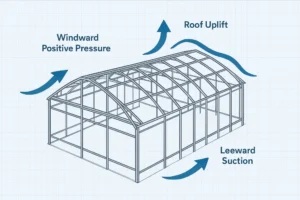
Wind pressure directly influences:
- Main frame strength
- Column design
- Connection details
- Bracing system
- Foundation interface
If available, buyers should provide:
- Basic wind speed
- Local design wind pressure
- Project standard or code reference
For more information, please refer to:
Greenhouse Snow Load and Wind Load Evaluation
Snow Conditions
Snow load requirements are especially important for cold-climate greenhouse projects.
Snow accumulation can affect:
- Roof structure
- Arches
- Purlins
- Gutters
- Supporting members
A supplier should understand whether the project requires:
- Standard snow load consideration
- Heavy snow region design
- Additional reinforcement
Humidity and Corrosion Exposure
Location also affects corrosion protection requirements.
Important factors include:
- Coastal environment
- High humidity
- Fertilizer exposure
- Chemical exposure
- Greenhouse internal climate
2. Greenhouse Area, Dimensions and Structural Layout
Project area is important, but dimensions define the actual structural system.
For a commercial greenhouse structure quotation, suppliers normally need:
Total Project Area
Examples:
- 5,000 m²
- 20,000 m²
- 100,000 m²
However, area alone does not define the structure.
Width and Length
Important information includes:
- Greenhouse width
- Greenhouse length
- Number of blocks
- Future expansion plan
Span Layout
For commercial greenhouses, span configuration strongly affects:
- Steel consumption
- Internal space
- Ventilation arrangement
- Equipment integration
Typical information includes:
- Number of spans
- Span width
- Bay spacing
- Arch spacing
Height Requirements
Important dimensions:
- Gutter height
- Side wall height
- Peak height
Higher greenhouses may provide better growing conditions, but they also influence:
- Wind pressure
- Material quantity
- Structural design
A complete dimensional layout helps suppliers prepare a more accurate structure proposal and BOM.
3. Greenhouse Type and Structural Form
Commercial greenhouse projects can use different structural systems depending on crop requirements, climate conditions, investment goals and operational needs.
Before quotation, the greenhouse type should be clearly identified because different structures require different design approaches, material quantities and connection details.
Common commercial greenhouse structures include:
Multi-Span Greenhouse
Multi-span greenhouses are widely used for commercial production because they provide efficient land utilization and large-scale growing space.
Important structural inputs include:
- Span width
- Number of spans
- Gutter layout
- Internal support arrangement
- Expansion requirements
For large commercial projects, the multi-span structure design directly affects steel quantity, ventilation space and future expansion flexibility.
Gothic Greenhouse
Gothic greenhouse structures are commonly selected where improved snow shedding performance and higher internal space are important.
The roof geometry can influence:
- Snow accumulation behavior
- Structural loading
- Internal growing height
- Ventilation conditions
Venlo Greenhouse
Venlo greenhouse systems are commonly used for professional commercial horticulture projects, especially where glass covering and high environmental control requirements are involved.
The quotation process should consider:
- Glass specification
- Aluminum or steel components
- Gutter system
- Structural connections
Film and Polycarbonate Greenhouses
Film and polycarbonate greenhouse systems are also widely used for commercial production.
Structural requirements may vary depending on:
- Covering thickness
- Single or double-layer film
- Panel dimensions
- Fixing methods
- Local climate conditions
A greenhouse structure quotation should always be based on the actual greenhouse system rather than only the project area.
4. Covering Material and Fixing System
The greenhouse covering material is not only an external layer. It directly affects structural design, fixing methods and load transfer.
Different covering systems create different requirements for the supporting frame.
Common covering materials include:
- Single-layer polyethylene film
- Double-layer inflated film
- Polycarbonate sheets
- Glass panels
- Shade net systems
Why Covering Material Matters for Structure
The covering system influences:
Frame Spacing
Different materials may require different support spacing and fixing details.
Load Transfer
Wind pressure and snow loads are transferred through the covering system to the greenhouse frame.
Therefore, covering material selection should be confirmed before final structural quotation.
Replacement and Maintenance Requirements
Some projects may require:
- Easy replacement of film
- Long-term panel durability
- Specific fixing systems
Providing covering information early helps suppliers prepare a more accurate structure proposal.
5. Wind Load, Snow Load and Site Exposure
Wind load and snow load are two of the most important structural inputs for commercial greenhouse projects.
They are not only technical parameters. They directly influence:
- Main frame design
- Arch or truss selection
- Purlin requirements
- Bracing systems
- Connection details
Before preparing a final greenhouse structure quotation, these conditions should be clarified as much as possible.
Wind Load Considerations
Wind conditions depend on:
- Project location
- Building exposure
- Surrounding terrain
- Greenhouse height
- Local design standards
A greenhouse located in an open coastal area may require different structural considerations compared with one located in a protected inland area.
Important wind-related information includes:
- Basic wind speed
- Design wind pressure
- Local structural requirements
- Special exposure conditions
Wind pressure affects not only the main steel frame but also:
- Connection strength
- Bracing arrangement
- Foundation interface
- Overall structural stability
For more details about structural load evaluation, please refer to:
greenhouse snow load and wind load evaluation
Snow Load Considerations
Snow load requirements are especially important for cold-climate greenhouse projects.
Snow accumulation can affect:
- Roof structure
- Arches
- Purlins
- Gutters
- Supporting members
Important snow-related information includes:
- Local snow load value
- Snow accumulation conditions
- Design standard
- Required reinforcement level
For regions with heavy snowfall, greenhouse structure selection should consider snow resistance during the early design stage.
A reliable quotation requires understanding these load conditions before finalizing structural specifications.
6. Galvanization and Corrosion Protection Requirements
Commercial greenhouse structures are commonly exposed to humid agricultural environments.
Therefore, corrosion protection requirements should be considered during the quotation stage.
Important factors include:
- Humidity level
- Coastal exposure
- Fertilizer environment
- Chemical exposure
- Expected service life
- Maintenance requirements
Hot-Dip Galvanized Steel for Greenhouse Structures
Hot-dip galvanization is widely used for commercial greenhouse steel structures because it provides corrosion protection through a zinc coating layer.
Common coating considerations include:
- Z275
- Z450
- Z600
The suitable coating requirement depends on the project environment rather than one standard for all locations.
For example:
A greenhouse located in a normal inland agricultural area may have different corrosion requirements compared with a greenhouse located near the coast or in a high-humidity environment.
When evaluating corrosion protection, buyers should consider:
- Local climate
- Greenhouse operating environment
- Fertilizer exposure
- Expected service period
For more information, please refer to:
zinc coating selection for greenhouse structures
7. Project Stage, Delivery and Supply Scope
The project stage directly affects quotation accuracy.
A supplier should understand whether the project is currently at:
| Project Stage | Typical Requirement |
|---|---|
| Concept Stage | Preliminary budget estimation |
| Design Stage | Technical discussion and structure review |
| Tender Stage | Detailed quotation and specification confirmation |
| Ready-to-Order Stage | Final BOM and production planning |
A concept-stage inquiry usually does not have the same information level as a ready-to-order project.
The quotation approach should match the actual project maturity.
Delivery and Export Scope
Before quotation, the supplier should also understand:
- Delivery country
- Destination port
- Packing requirements
- Labeling requirements
- Export documentation needs
A clear delivery scope helps avoid misunderstandings during project execution.
Important questions include:
- Is the buyer purchasing only steel structures?
- Are installation references required?
- Are special packing methods needed?
- Are project documents required?
A professional quotation should clearly define what is included and what is not included.
8. System Integration Boundary
A clear supply boundary is an important part of a professional commercial greenhouse structure quotation.
Many greenhouse projects include multiple systems, such as:
- Structural framework
- Environmental control
- Irrigation
- Electrical systems
- Automation systems
- Local construction
However, different suppliers may be responsible for different parts of the project.
Before quotation, buyers and suppliers should clearly define the supply boundary.
What CHIYANG GREENHOUSE Supports
CHIYANG focuses on:
Structure-First Commercial Greenhouse Supply
Our support includes:
Galvanized Greenhouse Steel Structures
Supply of greenhouse structural components manufactured according to project requirements.
Structure-Related BOM
Support for:
- Material lists
- Component organization
- Structural quantity review
Manufacturing Coordination
Support communication regarding:
- Specifications
- Materials
- Production requirements
- Delivery schedule
Packing and Export Preparation
Including:
- Export-oriented packing solutions
- Shipment coordination
- Document preparation support
Engineering Document Coordination
Support communication regarding technical documents related to the supplied structure.
What Usually Requires Local Partners
For international commercial greenhouse projects, some parts usually require cooperation with local integrators, contractors or qualified engineers, including:
- Local construction management
- Foundation design according to local conditions
- Electrical systems
- Irrigation systems
- Climate control systems
- Local permit approval
- Certified structural verification where required
CHIYANG can support preliminary structure review, material recommendations, BOM coordination and engineering communication.
However, formal local certification, stamped structural calculations or regulatory approval should be confirmed according to project location and completed by qualified local professionals where required.
A clear system boundary creates a more efficient and reliable project process.
9. Documents Needed for a Reliable Greenhouse Structure Quote
Providing complete project information helps suppliers prepare a more accurate quotation and avoid repeated clarification.
The following checklist can help prepare a commercial greenhouse structure RFQ.
| Information Required | Examples |
|---|---|
| Project location | Country, city, coordinates |
| Greenhouse area | Total m² |
| Dimensions | Width, length, height |
| Structural type | Multi-span, Gothic, Venlo, film greenhouse |
| Covering material | Film, PC sheet, glass |
| Wind information | Wind speed or design load |
| Snow information | Snow load requirement |
| Corrosion condition | Coastal, humid, fertilizer exposure |
| Steel coating requirement | Z275, Z450, Z600 |
| Crop information | Vegetable, flower, nursery |
| Project stage | Concept, tender, ready to order |
| Delivery destination | Country, port |
| Required documents | Drawings, BOM, manuals |
| Installation responsibility | Supplier scope or local installation |
The more complete these inputs are, the closer the quotation can be to the actual project requirements.
10. How CHIYANG Reviews a Greenhouse Structure Inquiry
A professional greenhouse structure quotation follows a structured review process.
At CHIYANG, a typical inquiry review includes:
Step 1: Confirm Project Background
Review:
- Project location
- Buyer role
- Project stage
- Expected timeline
Step 2: Identify Greenhouse System Requirements
Confirm:
- Greenhouse type
- Dimensions
- Covering material
- Structural configuration
Step 3: Review Structural Inputs
Check:
- Wind conditions
- Snow conditions
- Corrosion environment
- Service requirements
Step 4: Define Supply Scope
Clarify:
- Supplied components
- Required documents
- Installation responsibility
Step 5: Prepare Structure Proposal and Quotation Scope
Based on available information, CHIYANG can support:
- Preliminary structure discussion
- Material recommendations
- BOM preparation
- Quotation scope definition
A structured review process helps both suppliers and buyers reduce uncertainty before moving into the next project stage.
11. Common RFQ Mistakes That Delay a Greenhouse Quote
Incomplete information is one of the most common reasons why commercial greenhouse quotations require repeated clarification.
A clear and complete RFQ helps suppliers understand the project faster and prepare a more accurate structural proposal.
The following are common mistakes that may delay the quotation process.
Only Asking for Price Per Square Meter
Many buyers start an inquiry with:
“How much is the greenhouse structure per square meter?”
However, square-meter pricing alone cannot represent the actual structural requirements.
The final quotation depends on multiple factors, including:
- Greenhouse dimensions
- Structural type
- Climate conditions
- Covering material
- Corrosion requirements
- Supply scope
A reliable greenhouse structure quotation requires project information, not only project area.
No Project Location Provided
Project location is one of the most important inputs for greenhouse structure evaluation.
Without location information, suppliers cannot properly assess:
- Wind conditions
- Snow requirements
- Corrosion exposure
- Environmental conditions
Providing at least the country and region can significantly improve the quotation process.
No Wind Load or Snow Load Information
Wind load and snow load directly influence structural requirements.
Missing these inputs may result in:
- Incorrect structural assumptions
- Repeated technical discussions
- Changes after quotation
For cold-climate or high-wind projects, load information should be confirmed as early as possible.
Unclear Covering Material
Different covering systems require different structural solutions.
For example:
- Film greenhouse systems
- Polycarbonate greenhouse systems
- Glass greenhouse systems
may require different:
- Support spacing
- Fixing methods
- Connection details
- Structural considerations
Covering material should be confirmed before final quotation.
Unclear Greenhouse Type
A supplier needs to understand whether the project requires:
- Multi-span greenhouse
- Gothic greenhouse
- Venlo greenhouse
- Film greenhouse
- Polycarbonate greenhouse
- Shade or rain shelter structure
Different greenhouse types have different structural characteristics and quotation requirements.
No Delivery Destination
The delivery destination affects:
- Packing method
- Container planning
- Export documents
- Logistics arrangement
Providing the destination country and port helps suppliers define the complete quotation scope.
Unclear Project Stage
A supplier should understand whether the project is currently at:
- Concept planning stage
- Budget evaluation stage
- Tender preparation stage
- Engineering review stage
- Ready-to-order stage
Different project stages require different levels of quotation detail.
Assuming the Supplier Handles All Local Certification
International greenhouse projects usually involve multiple parties.
A structure supplier may support:
- Preliminary structure review
- Material recommendations
- BOM preparation
- Technical communication
However, local approval, certified calculations, stamped documents and regulatory compliance normally depend on the project location and should be confirmed with qualified local professionals.
A clear understanding of responsibilities helps prevent delays during project execution.
Conclusion
A reliable commercial greenhouse structure quotation requires more than a project area and a simple price request.
Project location, greenhouse dimensions, structural type, covering material, wind load, snow load, corrosion conditions and supply scope all influence the final structural solution.
The more complete the project information is, the more accurate and efficient the quotation process can become.
At CHIYANG GREENHOUSE, we support commercial greenhouse projects through structure-first supply, engineering communication and project information review.
By providing the right information at the beginning, project buyers, EPC teams and greenhouse integrators can reduce uncertainty and move toward a more reliable structural solution.
Request a Commercial Greenhouse Structure Review
Send your project information, and our team can help review the structural requirements, supply scope and quotation preparation needs.
Request a Commercial Greenhouse Structure Quote
Frequently Asked Questions
1. What information is needed to quote a commercial greenhouse structure?
A commercial greenhouse structure quotation usually requires project location, greenhouse dimensions, structural type, covering material, wind and snow load information, corrosion conditions, delivery destination and supply scope requirements.
2. Can a greenhouse structure be quoted by area only?
A project area can provide a preliminary reference, but a reliable quotation requires additional engineering information.
Structural requirements depend on climate conditions, dimensions, covering systems, corrosion exposure and project requirements.
3. Why does project location matter for greenhouse quotation?
Project location affects wind conditions, snow requirements, corrosion exposure and material protection selection.
A greenhouse structure designed for one environment may not be suitable for another location without adjustment.
4. Why are wind load and snow load needed before quotation?
Wind load and snow load influence:
- Main frame design
- Structural reinforcement
- Connection details
- Supporting components
They are essential inputs for reliable structural evaluation.
5. Does covering material affect greenhouse structure price?
Yes.
Different covering materials require different:
- Fixing systems
- Support spacing
- Structural considerations
Film, polycarbonate and glass greenhouse systems may require different structural approaches.
6. What is the difference between a preliminary quote and a final structure quotation?
A preliminary quotation is usually based on limited project information and provides a budget reference.
A final structure quotation requires confirmed technical inputs, specifications and supply scope.
7. What drawings should be provided for a greenhouse structure quote?
Useful documents include:
- Layout drawings
- Dimension drawings
- Structural sketches
- Technical specifications
- Local project requirements
If drawings are unavailable, basic project information can still help start the review process.
8. Does CHIYANG provide turnkey greenhouse systems?
CHIYANG focuses on structure-first commercial greenhouse supply.
We support:
- Galvanized greenhouse structures
- Structure-related BOM
- Manufacturing coordination
- Engineering communication
Complete turnkey execution usually requires cooperation with local integrators, contractors and project partners.
9. Can CHIYANG help review a greenhouse structure project before quotation?
Yes.
CHIYANG can support:
- Preliminary structure review
- Material discussion
- BOM preparation
- Supply scope clarification
- Engineering document coordination
This helps create a clearer quotation basis before moving forward.
10. Can CHIYANG provide certified structural calculations?
CHIYANG can support supplier-side structural review, material recommendations, BOM coordination and engineering document communication.
Formal certified calculations, local code verification or stamped documents should be confirmed according to the project location and completed by qualified local engineers where required.
Final Summary
A commercial greenhouse structure quotation is an engineering process, not simply a price calculation based on area.
By preparing complete project information before quotation, buyers and suppliers can achieve:
- Better structural understanding
- More accurate BOM planning
- Clearer supply boundaries
- More efficient project communication
A well-prepared RFQ creates a stronger foundation for successful commercial greenhouse projects.