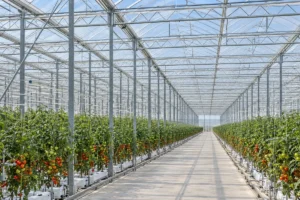
Film, polycarbonate, and glass can all be used in multi-span greenhouse projects, but they do not create the same structural requirements. Film is usually lighter and cost-efficient. Polycarbonate can improve insulation and impact resistance. Glass can provide high light transmission, but it usually requires stronger support, tighter installation tolerance, and more detailed engineering review.
For commercial projects, the covering material is not only a surface material.
It affects the way the roof is supported.
It affects how the covering is fixed.
It affects wind uplift resistance.
It affects snow-load response.
It affects gutter details, maintenance access, and quotation scope.
So when evaluating film vs polycarbonate vs glass greenhouse options, the right question is not only:
Which covering material is better?
The better question is:
Which covering material fits the project structure, local climate, fixing method, maintenance plan, and engineering responsibility?
Why Covering Material Matters in Multi-Span Greenhouse Projects
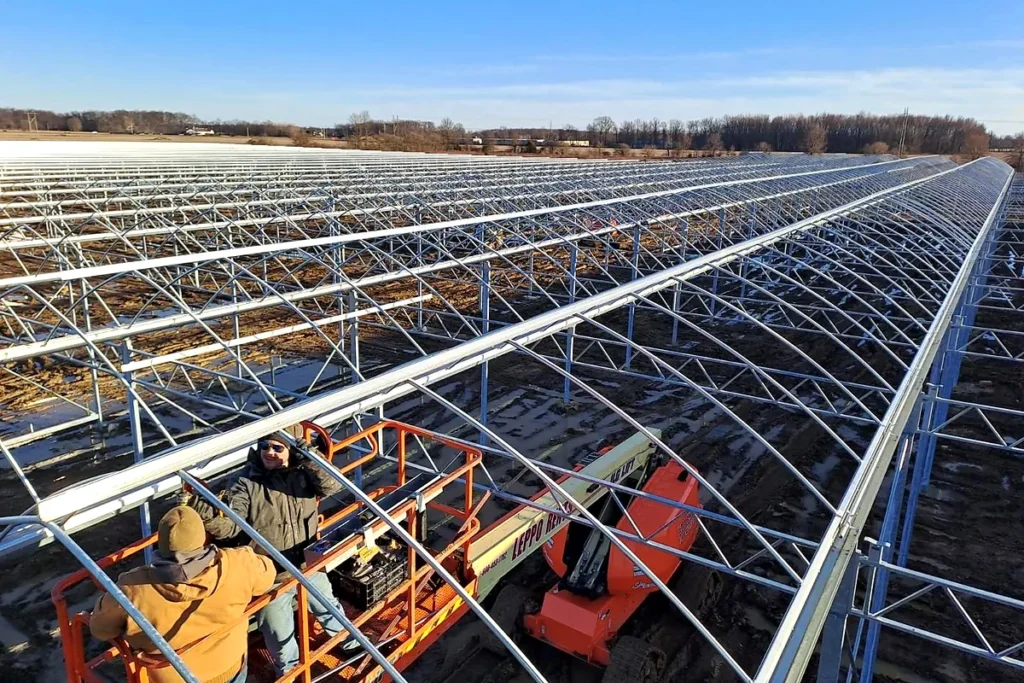
A multi-span greenhouse is a repeated structure.
The same roof logic, frame spacing, purlins, gutters, bracing, and fixing details may continue across many bays.
That repetition can make a project more efficient.
But it also means one wrong assumption can repeat many times.
If the covering material changes after the structure has already been fixed, the project may face problems with support spacing, fixing details, gutters, seals, wind resistance, snow performance, or maintenance access.
This is why covering material should be discussed early.
It should not be treated as a small purchasing decision after the steel structure is already confirmed.
In a commercial greenhouse project, the covering and the structure should be planned together.
The Key Rule: Covering Choice Must Match the Structure
The key rule is simple.
The greenhouse covering should match the structure.
Film, polycarbonate, and glass can all work in commercial greenhouse projects.
But each option needs a compatible structural arrangement.
That includes:
- roof frame layout;
- purlin or glazing support;
- fixing method;
- gutter connection;
- wind-load resistance;
- snow-load review;
- maintenance access;
- replacement planning;
- local engineering responsibility.
A covering material may look suitable on paper.
But if the fixing method, support spacing, or load path is not coordinated with the structure, it can still become a project risk.
That is why this comparison should not stop at material advantages.
It should continue into structural trade-offs.
Film Multi-Span Greenhouse: Flexible and Cost-Efficient
Film covering is commonly used in large commercial multi-span greenhouse projects.
It is often considered when the project area is large and initial investment control is important.
A film multi-span greenhouse usually uses flexible greenhouse film fixed to a compatible steel frame through locking channels, clips, profiles, or other film retention systems.
The film itself is relatively light compared with many rigid covering materials.
But lightweight does not mean risk-free.
Film still needs correct support, tensioning, fixing, and edge retention.
Wind suction can pull on the film and its fixing system.
If the film is not properly supported or retained, local damage can spread across a larger roof area.
What Film Covering Usually Means for the Structure
For the greenhouse structure, film covering usually means:
- lower covering dead load;
- flexible covering behavior;
- strong dependence on film tensioning;
- careful fixing and locking details;
- regular inspection;
- planned replacement during the project life cycle.
The key issue is not only the film.
The key issue is how the film connects to the greenhouse frame.
The roof frame, purlins, arch spacing, film locking system, and gutter-edge details should be coordinated before fabrication.
When Film Is Usually Worth Evaluating
Film is often worth evaluating first when the project is:
- large in area;
- cost-sensitive;
- located in a climate where the selected film system is suitable;
- planned with clear replacement access;
- supported by a practical maintenance plan.
However, film should not be selected only because it is cheaper at the beginning.
The project team should also consider wind exposure, fixing method, snow condition, maintenance cost, and replacement cycle.
Polycarbonate Multi-Span Greenhouse: Insulation and Impact Resistance
Polycarbonate is often considered when a commercial greenhouse project needs better insulation, selected impact resistance, or a more rigid covering system than film.
Multiwall polycarbonate panels can provide useful thermal performance.
But actual performance depends on the panel type, thickness, internal structure, coating, joint details, and installation quality.
Polycarbonate should not be treated as a simple “stronger plastic” replacement for film.
It is a panel system.
That means it needs defined support positions, edge fixing, sealing, and movement allowance.
What Polycarbonate Usually Means for the Structure
For the greenhouse structure, polycarbonate usually means:
- panel support spacing must be checked;
- panel weight should be included;
- panel edges need proper support;
- fixing profiles or fasteners must match the panel system;
- thermal expansion needs allowance;
- seals and joints must be coordinated with the roof structure.
Polycarbonate panels expand and contract with temperature.
If the fixing system does not allow movement, the panels may be damaged, restrained, or exposed to leakage problems.
This is why a polycarbonate multi-span greenhouse should be planned with the panel system in mind from the beginning.
When Polycarbonate Is Usually Worth Evaluating
Polycarbonate is often worth evaluating when the project needs:
- better insulation than film;
- a more rigid covering surface;
- selected impact resistance;
- controlled panel layout;
- a balance between performance and construction complexity.
Before finalizing the steel frame, the project team should confirm the actual panel specification.
That includes panel thickness, weight, width, allowable support spacing, fixing method, and installation guidance.
Glass Multi-Span Greenhouse: High Light and Higher Structural Requirements
Glass is often associated with high light transmission and long-term greenhouse glazing performance.
It may suit premium commercial greenhouse projects where optical performance and long-term operating goals are important.
But glass also creates higher structural and installation demands.
Compared with film, glass usually adds more permanent load to the roof.
This additional dead load must be considered in the structural review.
The supporting frame, glazing bars, gutters, connections, and foundation assumptions may all need closer evaluation.
What Glass Usually Means for the Structure
For the greenhouse structure, glass usually means:
- higher covering dead load;
- more precise support requirements;
- suitable glazing bars or support profiles;
- controlled edge support;
- stricter installation tolerance;
- glass retention under wind suction;
- safe replacement planning.
Glass is a brittle material.
It does not behave like flexible film or impact-resistant plastic panels.
The support system must avoid inappropriate point loading, excessive movement, poor alignment, or direct contact that may damage the glass.
When Glass Is Usually Worth Evaluating
Glass may be worth evaluating when the project requires:
- high light transmission;
- long-term glazing performance;
- premium commercial greenhouse positioning;
- stable construction quality;
- detailed engineering review;
- planned maintenance and safe replacement access.
Glass should not be selected only because it looks premium.
It should be selected only when the glazing specification, support system, installation tolerance, maintenance plan, and local engineering review are aligned.
Basic Comparison: Film, Polycarbonate, and Glass
| Covering Option | Main Advantage | Structural Impact | Maintenance Consideration | Best-Fit Project Type |
|---|---|---|---|---|
| Film | Lower typical initial covering cost | Lightweight covering; depends on tensioning, support, and fixing method | Periodic inspection and planned replacement | Large-area, cost-sensitive commercial greenhouse projects |
| Polycarbonate | Better insulation and selected impact resistance | Rigid panels require compatible support, fixing, sealing, and movement allowance | Panel cleaning, seal inspection, and possible panel replacement | Commercial projects requiring better insulation or selected impact performance |
| Glass | High light transmission and long-term glazing performance | Higher typical dead load, precise support, and stricter installation tolerance | Cleaning, breakage inspection, and safe glass replacement | Long-term premium commercial greenhouse projects |
There is no single best covering for all multi-span greenhouse projects.
The right choice depends on:
- project location;
- local wind condition;
- local snow condition;
- roof geometry;
- covering specification;
- fixing method;
- gutter detail;
- maintenance plan;
- replacement cycle;
- budget;
- local engineering responsibility.
The covering material should be selected as part of the structure planning, not after the structural proposal is already fixed.
How Covering Material Affects Greenhouse Structure Design
A covering material affects more than the appearance of the greenhouse.
It can change the way the roof is supported, connected, fixed, maintained, and reviewed.
Purlin Layout
Purlins and secondary supports transfer covering loads to the main greenhouse frame.
Film may require supports that help control membrane movement and keep the covering properly tensioned.
Polycarbonate panels need support spacing that matches the panel strength, thickness, width, and installation rules.
Glass may require glazing bars or dedicated support profiles instead of ordinary purlins alone.
There is no universal purlin spacing for film, polycarbonate, and glass.
The support layout must be confirmed according to covering material, product data, design load, and local engineering review.
Roof Frame Strength
The roof frame must resist dead load, wind load, snow load, and other project-specific loads.
Film is lighter, but wind uplift and snow load may still control the design.
Polycarbonate adds panel weight and support requirements.
Glass usually adds higher dead load and stricter support requirements.
A stronger-looking covering does not automatically make the greenhouse safer.
The whole load path must be checked.
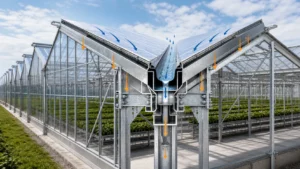
Gutter Connection
In a multi-span greenhouse, gutters are not just drainage accessories.
They often sit between repeated roof bays and connect with roof edges, covering terminations, columns, frame members, and drainage routes.
Changing the covering material may affect the gutter interface.
Film needs suitable termination and locking details near the gutter.
Polycarbonate needs panel edge support, sealing, and drainage coordination.
Glass needs glazing termination details and precise support near the roof edge.
Poor gutter coordination can lead to water leakage, snow accumulation risk, local corrosion, or installation problems.
Covering Fixing Method
The fixing method is one of the biggest differences between film, polycarbonate, and glass.
Film depends on compatible locking, clamping, or tensioning systems.
Polycarbonate may use retaining profiles, fasteners, gaskets, and movement allowance.
Glass requires glazing support, retention, and safe edge details.
A covering material should not be approved only by looking at the sheet or panel.
The fixing system must also be reviewed.
Bracing and Frame Stability
Bracing helps transfer lateral loads and stabilize the greenhouse frame.
Covering material selection may affect permanent loads, local stiffness, and connection behavior.
But a rigid covering should not be assumed to act as structural bracing unless the system is specifically designed and verified for that purpose.
Frame stability must be reviewed independently.
Structural Impact by Covering Material
| Structure Area | Film Impact | Polycarbonate Impact | Glass Impact | Buyer Note |
|---|---|---|---|---|
| Roof frame | Lower covering dead load, but wind and snow may still govern | Panel weight and support requirements affect frame design | Higher typical dead load and stricter support requirements | Check the full load combination, not only material weight |
| Purlins / supports | Needs support for membrane behavior and proper tensioning | Support spacing must match panel thickness, width, and allowable span | May require glazing bars or dedicated support profiles | Do not copy spacing from another covering system without review |
| Gutter connection | Needs film termination and locking details near the gutter | Needs panel edge support, sealing, and drainage coordination | Needs glazing termination details and precise support near roof edges | Poor gutter coordination can create leakage, snow, or corrosion problems |
| Covering fixing | Depends on locking, clamping, or tensioning systems | Uses retaining profiles, fasteners, gaskets, and movement allowance | Requires glazing support, retention, and safe edge details | The fixing system must be reviewed together with the covering |
| Wind load | Wind may affect film tension, locking channels, clips, and edge retention | Wind may affect fasteners, panel edges, retaining profiles, and withdrawal risk | Wind may affect glazing retention, support profiles, and local pressure zones | Material strength alone does not guarantee wind performance |
| Snow load | Snow may affect support behavior and drainage areas | Snow may affect panel support and roof assembly | Snow may affect glazing support, roof frame, and gutter condition | Roof geometry and local snow condition matter |
| Bracing and stability | Frame stability must still be checked | Frame stability and connection behavior must still be checked | Rigid covering should not be assumed to act as structural bracing | Review the structural load path independently |
| Installation tolerance | Film installation depends on tensioning and alignment | Panel fixing depends on layout, joint control, and movement allowance | Glass requires tighter tolerance and more precise support | Tolerance affects long-term performance and replacement |
Wind Load, Snow Load, and Covering Fixing
Wind and snow should not be evaluated only at the primary frame level.
The covering, fixing method, secondary support, gutters, and connections all form part of the load path.
A covering that performs well as a material can still become a project risk if its retention system, panel support, edge detail, or gutter interface is not coordinated with the greenhouse structure.
Wind Load and Uplift
Wind can create pressure and suction on greenhouse surfaces.
In some locations, uplift can be one of the most critical risks for the covering and its fixing system.
For film systems, wind may affect:
- film tension;
- locking channels;
- clips;
- edge retention;
- local tearing risk.
For polycarbonate systems, wind may affect:
- fasteners;
- retaining profiles;
- panel edges;
- panel withdrawal risk;
- seal performance.
For glass systems, wind may affect:
- glazing retention;
- support profiles;
- local pressure zones;
- edge support;
- replacement risk after damage.
The engineering review should follow the complete load path:
covering → fixing system → secondary support → primary frame → bracing → connections → foundations
If one part of this chain is unclear, the covering selection is not complete.
Snow Load and Roof Geometry
Snow load depends on local climate, roof shape, heat condition, gutter layout, and possible snow accumulation areas.
Multi-span greenhouses may have gutters or valleys between roof bays.
These areas need careful review because snow, ice, and blocked drainage can increase local risk.
Film should not be assumed to shed snow automatically.
Polycarbonate should not be assumed safe simply because it is rigid.
Glass should not be assumed safe simply because it is premium.
The final design must consider the local snow-load requirement, roof geometry, support layout, gutter condition, and applicable engineering code.
Cost, Maintenance, and Replacement Trade-Offs
The lowest initial covering price is not always the lowest project cost.
A commercial greenhouse project should compare both initial cost and lifecycle cost.
Film may reduce initial covering cost.
But the project should still plan for inspection, repair, replacement, access, and possible production interruption.
Polycarbonate may cost more than film at the beginning.
But it may support better insulation or impact resistance in suitable projects.
Glass may support long-term optical goals.
But it usually requires more precise support, careful installation, safe replacement planning, and more detailed structural review.
For EPC teams and project buyers, a useful comparison should include:
- covering material cost;
- steel structure support cost;
- fixing and accessory cost;
- freight and packing risk;
- installation method;
- maintenance access;
- cleaning requirements;
- replacement cycle;
- project downtime;
- local engineering review.
This is where many quotation differences appear.
One supplier may quote only the steel frame.
Another may include part of the covering support system.
Another may include glazing accessories.
If the quotation scope is not clear, the price comparison can be misleading.
Which Covering Fits Different Commercial Project Conditions?
| Project Condition | Better Covering Option | Reason | Engineering Note |
|---|---|---|---|
| Large-area cost-sensitive project | Film often worth evaluating first | Usually lower initial covering investment | Confirm fixing method, wind exposure, and replacement plan |
| Better insulation requirement | Polycarbonate | Multiwall panels may improve thermal performance | Verify actual panel data and the full roof assembly |
| High light transmission priority | Glass or verified high-transmission alternatives | May support stronger optical performance for premium projects | Compare actual glazing specification and support requirements |
| High wind region | No universal winner | Fixing method and complete load path are more important than material name alone | Review uplift, internal pressure, edge zones, and local pressure areas |
| Snow region | Site-specific engineered system | Roof geometry, gutter layout, and snow accumulation are critical | Confirm snow load, gutter condition, and roof support arrangement |
| Humid or coastal project | Depends on the complete system | Moisture and corrosion can affect steel, fasteners, and interface details | Review zinc coating, fasteners, drainage, and corrosion exposure |
| Fast installation need | System-dependent | Prefabrication, fixing details, and installer capability affect installation speed | Confirm installation method before finalizing the quotation |
| Long-term premium project | Glass or a specified rigid panel system | May support long-term optical and operational goals | Review lifecycle cost, maintenance plan, and local engineering responsibility |
This section is for early project evaluation.
It is not a substitute for engineering review.
What EPC Teams Should Confirm Before Quotation
A supplier can prepare a more useful structure proposal when the project information is clear.
“Multi-span greenhouse with film” is not enough.
“Polycarbonate greenhouse” is not enough.
“Glass greenhouse” is not enough.
The project team should confirm the actual project conditions.
| Check Area | What to Confirm | Why It Matters | Related Next Step |
|---|---|---|---|
| Project location | Country, city, site exposure, and local climate conditions | Location affects wind load, snow load, corrosion exposure, and engineering responsibility | Collect complete site information before requesting a final quotation |
| Wind load | Local wind requirement and site exposure | Wind affects the frame, fixing system, covering retention, and connection details | Arrange local engineering review or provide required wind-load information |
| Snow load | Local snow requirement and possible roof accumulation conditions | Snow affects the roof frame, purlins, gutters, and covering support | Check snow-load requirements before confirming the roof structure |
| Covering material | Film, polycarbonate, glass, or a mixed covering system | Each covering material creates different structural interface requirements | Provide the covering material specification and technical data |
| Fixing method | Locking channels, profiles, fasteners, glazing supports, or another fixing system | The fixing method controls load transfer and installation quality | Review fixing details before fabrication |
| Purlin layout | Support spacing and secondary member arrangement | Purlin layout affects covering support and structural compatibility | Coordinate purlin layout with the selected covering system |
| Gutter connection | Drainage, roof edge support, and gutter interface details | Gutters affect water control, roof edges, and load transfer | Review gutter details together with the roof covering system |
| Maintenance plan | Inspection, cleaning, repair access, and replacement access | Maintenance affects long-term greenhouse operation | Plan safe and practical maintenance access |
| Replacement cycle | Expected covering replacement requirement | Replacement affects lifecycle cost, downtime, and long-term project planning | Confirm supplier guidance and maintenance assumptions |
| Corrosion exposure | Humid, coastal, fertilizer-rich, or chemically exposed environment | Exposure affects steel coating and fastener selection | Confirm zinc coating and corrosion protection requirements |
| BOM and quotation scope | Included and excluded components | One quotation may include only the frame, while another may include covering support or accessories | Reconcile the quotation scope before comparing prices |
| Local engineering responsibility | Who is responsible for local code compliance, certified calculations, stamped drawings, foundation design, and approvals | Structural supply and local engineering responsibility are not the same thing | Confirm the role of the EPC team, local engineer, or project integrator |
The purpose of collecting this information is not paperwork.
It reduces assumptions.
And fewer assumptions usually mean a more useful quotation.
Common Covering Selection Mistakes
Many covering problems begin before fabrication.
They begin when the covering is treated as a purchasing item instead of a structural interface.
| Mistake | What Happens Later | How to Prevent It | Related Design Check |
|---|---|---|---|
| Choosing only by initial price | Lifecycle cost may be underestimated | Compare installed cost, maintenance cost, replacement cost, and downtime | Cost review |
| Ignoring wind suction | Covering or fixing failure risk increases | Review uplift, fixing strength, edge zones, and retention details | Wind-load check |
| Ignoring snow load | Roof members or gutters may be under-designed | Check snow accumulation, roof geometry, and support arrangement | Snow-load check |
| Ignoring fixing method | Components may not match onsite installation requirements | Confirm fixing details before fabrication | Connection review |
| Ignoring purlin spacing | The covering may be poorly supported | Follow the covering system requirements and engineering review | Support layout |
| Ignoring glass dead load | Frame assumptions may be wrong | Include glazing weight in the structural design review | Dead-load check |
| Ignoring replacement cycle | Maintenance budget may become unrealistic | Plan repair, replacement, and access requirements early | Lifecycle planning |
| Ignoring corrosion exposure | Steel, fasteners, or interface components may deteriorate early | Select suitable coating, fasteners, and drainage details | Corrosion review |
These mistakes are common because covering material is often treated as a separate supply item.
For a commercial multi-span greenhouse, that is risky.
Supplier Boundary and Local Engineering Responsibility
CHIYANG GREENHOUSE focuses on structure-first commercial greenhouse supply.
For multi-span greenhouse projects, the supply scope may include:
- greenhouse steel structure proposal;
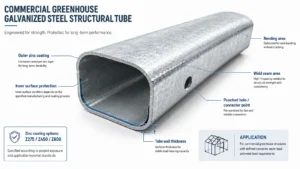
- galvanized steel members;
- material specification coordination;
- structural BOM;
- packing list;
- installation reference;
- export project support;
- structure-related engineering document coordination.
The role is deliberately structure-first.
CHIYANG can discuss how different covering options may affect the greenhouse frame and structural interface.
But CHIYANG should not be understood as a covering material manufacturer, local installer, climate-control supplier, irrigation supplier, automation supplier, or turnkey greenhouse contractor.
Final covering selection, covering material supply, local code verification, certified structural calculations, stamped drawings, foundation design, irrigation design, climate-control design, automation design, and onsite installation responsibility should be confirmed by the responsible EPC team, covering supplier, system integrator, local engineer, or qualified project party.
This boundary is important.
It helps the project team separate structural supply scope from local engineering and system integration responsibility.
Multi-Span Greenhouse Covering Selection Checklist
Before confirming a multi-span greenhouse covering material, project teams should answer the following questions.
What is the project location?
What are the local wind requirements?
What are the local snow requirements?
Is the covering film, polycarbonate, glass, or a mixed system?
What is the covering material weight?
What fixing method will be used?
What purlin or glazing support layout is required?
How does the covering connect to the gutter?
What maintenance access is required?
What is the expected replacement cycle?
What corrosion exposure should be considered?
What zinc coating or fastener specification is suitable?
What is included in the steel structure quotation?
What is excluded from the quotation?
Who is responsible for local engineering verification?
If these points are not clear, the covering decision is not ready for final structural quotation.
Frequently Asked Questions
Which covering material is best for a multi-span greenhouse?
There is no universal best covering material.
Film is often cost-efficient.
Polycarbonate can improve insulation and impact resistance.
Glass can offer high light transmission.
The best option depends on project location, climate, structure, fixing method, maintenance plan, budget, and local engineering review.
Is a film greenhouse cheaper than polycarbonate or glass?
Film usually has a lower initial covering cost than polycarbonate or glass.
However, the final project cost also depends on structure, fixing accessories, installation, maintenance, replacement cycle, and project downtime.
A lower initial material price does not always mean a lower lifecycle cost.
Does glass require a stronger greenhouse structure?
Glass usually creates higher dead load and stricter support requirements than film.
A glass greenhouse may need stronger members, precise glazing supports, better stiffness control, and more detailed structural review.
The actual design should be confirmed according to project conditions and local engineering requirements.
How does polycarbonate affect greenhouse frame design?
Polycarbonate panels require compatible support spacing, fixing profiles, sealing, edge support, and thermal movement allowance.
The greenhouse frame should be coordinated with the actual panel specification and installation requirements.
It should not simply copy the layout of a film-covered greenhouse.
How does wind load affect covering material selection?
Wind load affects the covering, fixing system, support members, frame, and connections.
A material that looks strong can still fail if the fixing system or edge detail is not suitable for the site wind condition.
The complete load path should be reviewed.
How does snow load affect film, polycarbonate, or glass greenhouses?
Snow load can affect roof frames, purlins, gutters, covering support, and drainage areas.
Film, polycarbonate, and glass all require snow-load review based on roof geometry, local climate, and engineering requirements.
No covering should be assumed safe without review.
Can a multi-span greenhouse use different covering materials?
Yes, a multi-span greenhouse can use different covering materials in some projects.
For example, one project may use film on the roof and rigid panels on selected side areas.
However, each material still needs compatible support, fixing, sealing, drainage, and structural review.
What should EPC teams confirm before choosing covering material?
EPC teams should confirm project location, wind load, snow load, covering specification, fixing method, purlin layout, gutter connection, maintenance access, corrosion exposure, quotation scope, and local engineering responsibility.
These inputs help reduce assumptions before quotation.
Does CHIYANG supply greenhouse covering materials?
CHIYANG focuses on commercial greenhouse steel structures and related project support.
Covering materials should be confirmed with the responsible covering supplier, EPC team, or project integrator.
CHIYANG can discuss how the selected covering option may affect the structure and interface requirements.
Does CHIYANG provide full turnkey greenhouse systems?
No.
CHIYANG is a structure-first commercial greenhouse structure supplier.
We support structural proposals, steel components, BOM, packing list, installation reference, and export coordination.
We do not position ourselves as a full turnkey greenhouse contractor.
Conclusion
The choice between film, polycarbonate, and glass should not be made only by comparing material price or appearance.
For commercial multi-span greenhouse projects, covering material affects roof support layout, fixing method, wind uplift resistance, snow-load response, gutter connection, maintenance planning, and quotation scope.
Film can be cost-efficient for large-area projects.
Polycarbonate can support insulation and selected impact-resistance goals.
Glass can fit long-term premium projects with higher optical requirements.
But every option must match the structure.
The practical decision is not simply:
Which covering is best?
The better question is:
Which covering material fits the project structure, local climate, maintenance plan, and engineering responsibility?
CHIYANG GREENHOUSE supports commercial greenhouse projects with a structure-first supply approach.
If you are planning a multi-span greenhouse project, share your project dimensions, location, proposed covering material, wind and snow requirements, and expected supply scope.
These details help evaluate the structural frame, BOM, packing scope, and quotation direction more responsibly.