Selecting a multi span greenhouse supplier for a commercial project is not simply a matter of comparing steel prices or greenhouse cost per square meter.
For EPC contractors, greenhouse integrators, commercial growers, engineering companies, and agricultural investors, the supplier becomes part of the project execution chain. Structural suitability, manufacturing consistency, corrosion protection, engineering documentation, packing accuracy, and technical communication can all affect how smoothly the project moves from design review to installation.
A lower initial quotation does not necessarily mean a lower project cost if structural assumptions are unclear, components arrive with dimensional inconsistencies, documentation is incomplete, or the supplied structure does not match the actual climate and installation conditions.
A reliable commercial greenhouse supplier should therefore be evaluated from both an engineering perspective and a project-risk perspective.
The key questions are:
- Is the proposed structure suitable for the project conditions?
- Can the supplier manufacture the structure consistently?
- Is the corrosion protection appropriate for the environment?
- Can engineering information be communicated clearly?
- Is the quotation based on enough project information to be reliable?
- Is the supplier’s responsibility clearly separated from local EPC and system-integration responsibilities?
For commercial projects, these questions usually matter more than comparing headline prices alone.
What Is a Multi-Span Greenhouse Supplier?
A multi-span greenhouse supplier provides the structural system and related project support required to build connected greenhouse bays for commercial agricultural use.
Depending on the supplier’s scope, this may include galvanized steel columns, arches, or trusses; gutters; bracing; purlins; connection components; structural drawings; bills of materials; packing documentation; and installation references.
A structure-focused supplier such as CHIYANG GREENHOUSE concentrates on the greenhouse structural package and engineering coordination.
Climate-control systems, irrigation, automation, cultivation equipment, electrical systems, local construction, and regulatory approvals may be managed separately by local EPC contractors, greenhouse integrators, or specialist partners.
This greenhouse system integration boundary should be understood before comparing suppliers.
1. Why Supplier Selection Matters in Commercial Multi-Span Greenhouse Projects
A commercial multi-span greenhouse is normally a long-term production asset rather than a temporary agricultural shelter.
Projects may cover thousands or tens of thousands of square meters and involve multiple parties, including investors, designers, manufacturers, contractors, installers, system suppliers, agronomists, and local engineering teams.
A supplier problem can therefore affect more than the purchase order.
Typical consequences may include:
- structural changes after quotation;
- installation difficulties caused by inaccurate components;
- delayed containers or missing parts;
- incompatible connection details;
- higher local labor requirements;
- corrosion problems during the operating period;
- repeated technical clarifications;
- unexpected material or freight costs; and
- delays between structure installation and system integration.
For an EPC contractor, these problems can affect the project schedule.
For an integrator, they can create interface problems between the greenhouse frame and ventilation, shading, irrigation, or climate systems.
For an investor or grower, they can increase project uncertainty and lifecycle cost.
Supplier evaluation should therefore answer a broader question:
Can this supplier help reduce execution risk throughout the structural package—not simply provide steel at an attractive price?
How Should Buyers Evaluate Greenhouse Suppliers?
Commercial buyers should evaluate suppliers across five main areas:
Engineering capability + manufacturing capability + material protection + documentation + project communication.
Price remains important, but it should be compared only after the proposed structural scope, specifications, responsibilities, and project assumptions are sufficiently clear.
2. Evaluate Multi-Span Greenhouse Structure Engineering Capability
Engineering capability is one of the first areas to review when evaluating a multi span greenhouse supplier.
A multi-span greenhouse is a connected structural system. Span width, column spacing, gutter configuration, roof geometry, bracing, covering material, wind conditions, snow conditions, internal clearance, and structural connections interact with each other.
The structure should therefore not be selected from area alone.
For a deeper explanation of these relationships, see our guide to multi span greenhouse design.
Why Engineering Capability Matters in Commercial Greenhouse Projects
Engineering capability matters because project conditions determine structural demand.
A greenhouse used in a mild inland environment may not require the same structural configuration as one exposed to strong winds, snow accumulation, coastal conditions, or significant suspended equipment.
The supplier should understand how project inputs affect the proposed structure.
Important areas to evaluate include:
Structural Design Experience
The supplier should be familiar with commercial greenhouse structural layouts rather than only producing generic agricultural steel frames.
This includes understanding:
- connected span arrangements;
- column and bay spacing;
- roof structural configuration;
- gutter support;
- bracing logic;
- structural connections;
- covering interfaces;
- ventilation openings; and
- installation sequence.
Span Configuration
Span selection affects more than internal width.
A wider span may improve usable internal space, but it can also change member demand, deflection, roof geometry, steel consumption, connection requirements, and bracing arrangements.
The selected multi-span greenhouse structure should therefore reflect the operational layout as well as structural requirements.
Wind and Snow Conditions
A commercial greenhouse supplier should ask about project location and applicable design conditions before finalizing the structure.
Wind can create pressure, suction, uplift, and lateral forces.
Snow can create downward loading and, depending on geometry and local conditions, uneven accumulation.
These loads can influence:
- arches, rafters, or trusses;
- columns;
- purlins;
- gutters;
- bracing;
- connections;
- anchors; and
- foundation interfaces.
The exact local design basis should ultimately be reviewed according to applicable project requirements and qualified local engineering procedures where necessary.
For reference, BS EN 13031-1:2019 sets out principles and requirements for the mechanical resistance, stability, serviceability, and durability of commercial production greenhouse structures.
Engineering Documentation
Ask what technical documentation can be provided during the project.
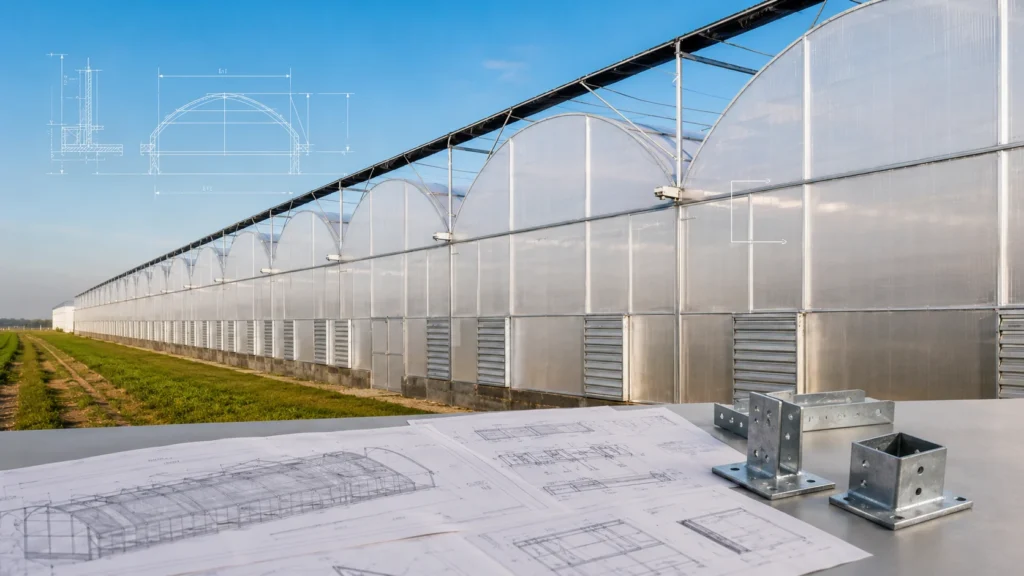
Depending on project scope, useful documents may include layout drawings, structural drawings, component drawings, connection details, BOMs, installation references, and other structure-related project documents.
A supplier does not need to replace the local engineering authority to provide useful engineering support.
What matters is whether the structural package is documented clearly enough for EPC teams and local engineers to review and coordinate.
3. Check Manufacturing Capability Before Choosing a Supplier
Good drawings do not automatically produce good greenhouse structures.
The next question is whether the multi-span greenhouse manufacturer can repeatedly manufacture the required components within the agreed specification.
Commercial projects often involve hundreds or thousands of repeated steel parts. Small dimensional inconsistencies can become significant when repeated across a large greenhouse block.
Buyers should therefore examine the manufacturing process behind the quotation.
Galvanized Steel Processing
Confirm what steel profiles, tubes, or fabricated components are used and how their material specifications are controlled.
Important items may include:
- profile dimensions;
- wall thickness;
- steel grade;
- zinc coating specification;
- hole position;
- cut length; and
- connection interface.
Profile Forming Capability
Columns, purlins, gutters, channels, and other greenhouse components may require controlled forming.
Repeatability matters because standardized structural components must connect correctly across large project areas.
Welding and Fabrication Control
Where welded assemblies or fabricated brackets are required, buyers should evaluate whether the supplier has defined fabrication and inspection procedures.
Welding quality is only one part of the issue. Jig positioning, hole alignment, plate dimensions, distortion control, and finishing can also affect site installation.
Dimensional Consistency
A commercial structure should be designed for repeatable assembly.
Key dimensions should therefore be checked during production rather than discovered during installation.
This is particularly important for:
- repeated column positions;
- arch or truss geometry;
- bolt holes;
- connector plates;
- gutter connections; and
- bracing interfaces.
Quality Inspection
Ask what is inspected before packing.
A professional manufacturing process should include appropriate checks for materials, component dimensions, fabrication quality, quantities, and packaging identification according to the agreed project requirements.
For large commercial greenhouse projects, manufacturing consistency is not merely a factory issue. It directly affects installation productivity.
4. Review Corrosion Protection and Material Quality
Commercial greenhouse structures operate in environments where steel may be exposed to moisture, condensation, irrigation, fertilizers, and repeated wet-dry cycles.
External climate is only part of the corrosion environment.
The internal greenhouse environment may also create localized corrosion pressure around gutters, overlapping connections, column bases, wet zones, and areas with limited drying.
For this reason, supplier evaluation should include greenhouse corrosion protection, not simply the statement that the steel is “galvanized.”
For a more detailed comparison, see our guide to greenhouse corrosion protection.
Z275, Z450, and Z600 Considerations
Coating designations such as Z275, Z450, and Z600 represent different zinc coating mass levels under relevant galvanized-steel specifications.
A higher coating mass generally provides a larger zinc protection reserve, but the appropriate choice depends on the project environment and specification.
The decision should consider:
| Project Factor | Why It Matters |
|---|---|
| Inland or coastal location | Salinity and atmospheric exposure vary |
| Greenhouse humidity | Condensation may increase wetness duration |
| Irrigation environment | Repeated moisture exposure can affect steel |
| Chemical exposure | Fertilizer and production conditions may increase corrosion risk |
| Maintenance access | Some members are difficult to maintain after commissioning |
| Required service period | Long-life projects may justify stronger protection |
Z275 should not automatically be considered inadequate, and Z600 should not automatically be considered necessary.
The correct approach is to match corrosion protection to the actual project exposure.
For coastal, highly humid, or long-lifecycle projects, additional coating protection or alternative corrosion-control strategies may need to be reviewed.
Buyers should also confirm exactly which structural components are covered by the agreed coating specification rather than assuming one coating description applies identically to every component.
5. Confirm Project Support and Engineering Documentation
Commercial greenhouse procurement involves information as well as physical products.
For EPC contractors and integrators, a well-organized greenhouse engineering package can significantly reduce technical confusion during procurement, installation, and project coordination.
Depending on the agreed scope, buyers should discuss the availability of the following documentation.
Bill of Materials
The BOM should help identify the main structural components, quantities, and material organization.
A structured BOM can support:
- quotation comparison;
- procurement review;
- component checking;
- shipment preparation; and
- site material management.
Structural and Layout Drawings
Drawings provide the common technical language between the supplier, buyer, local engineer, and installation team.
They can help define:
- greenhouse dimensions;
- span layout;
- column positions;
- roof geometry;
- main structural members;
- connections; and
- installation relationships.
Installation Information
The supplier should clarify what form of installation support is included.
This may include assembly drawings, installation manuals, component identification, or remote technical communication.
Local construction management and labor normally remain the responsibility of the EPC contractor or local installation team unless otherwise agreed.
Packing List and Identification
Export greenhouse structures can contain large quantities of similar components.
Clear packing identification helps reduce time spent searching for parts after containers arrive on site.
Packing documentation should therefore be treated as part of project execution rather than as an administrative afterthought.
Technical Communication
Commercial projects rarely proceed without technical questions.
A useful greenhouse structure supplier should be able to communicate about dimensions, structural interfaces, material specifications, drawings, packing, production status, and design changes in an organized way.
Good technical communication does not eliminate project changes.
It makes changes easier to identify, evaluate, and control.
6. Understand Supplier vs Turnkey Integrator Roles
One of the most important questions in supplier selection is:
What exactly is the supplier responsible for?
Commercial greenhouse projects normally involve multiple technical disciplines. Trying to describe every participant as a complete turnkey provider can create unclear responsibilities.
A structure-focused supplier and a greenhouse EPC or integrator perform different roles.
| Structure Supplier | EPC / Greenhouse Integrator |
|---|---|
| Greenhouse steel structure | Overall project integration |
| Structural components | Climate-control systems |
| Structure-related engineering support | Heating and cooling |
| Structural drawings and BOM | Irrigation and fertigation |
| Manufacturing | Automation and control |
| Packing and export preparation | Cultivation systems |
| Installation references | Local construction management |
| Structural interface coordination | Electrical and local system coordination |
CHIYANG GREENHOUSE focuses on the structural side of commercial greenhouse projects.
Our core supply scope includes:
- galvanized greenhouse steel structures;
- structural components;
- structure-related engineering support; and
- project documentation.
Climate-control systems, irrigation, shading, automation, crop-production systems, electrical works, local permitting, and local installation may be supplied or managed by qualified EPC contractors, greenhouse integrators, and specialist partners.
This structure-first model is particularly useful for international projects because it allows responsibilities to remain clear.
The local project team can select systems that match regional climate conditions, crop strategy, service availability, local codes, and operating preferences, while the structural supplier concentrates on manufacturing and supporting a reliable structural platform.
For buyers, a clearly defined boundary is often safer than an unclear claim that one supplier is responsible for everything.
7. Questions Buyers Should Ask Before Requesting a Quote
A quotation is only as reliable as the information behind it.
Two greenhouse projects with the same area can require different steel quantities, structural configurations, coating specifications, documentation, and packing solutions.
Before requesting a greenhouse structure quotation, prepare the main project inputs.
Our detailed greenhouse structure quotation checklist explains these requirements further.
1. Where Is the Project Located?
Provide the country, region, or project location.
This helps the supplier understand possible wind, snow, corrosion, climate, logistics, and local engineering considerations.
2. What Is the Greenhouse Size?
Provide:
- total project area;
- greenhouse width and length;
- number of blocks;
- preferred span configuration; and
- expansion requirements.
Area alone is not enough to define the structural layout.
3. What Span and Height Are Required?
If already known, provide:
- span width;
- bay or column spacing;
- gutter height;
- peak height; and
- internal clearance requirements.
If these dimensions have not been finalized, explain the crop, operational layout, covering system, and project objectives so they can be discussed during structural review.
4. What Are the Climate and Design Conditions?
Provide available information about:
- wind speed or design wind pressure;
- snow load;
- coastal exposure;
- humidity;
- altitude; and
- other relevant environmental conditions.
Do not assume one standard structure is suitable for every region.
5. What Covering Material Will Be Used?
Film, polycarbonate, glass, shade materials, and other covering systems create different structural and connection requirements.
The covering should therefore be identified before the final structural proposal.
6. What Documents Are Required?
Confirm whether the project requires:
- BOM;
- structural drawings;
- component drawings;
- packing list;
- installation manual;
- material documentation; or
- other project-specific engineering information.
7. Who Will Handle Installation and System Integration?
Clarify responsibilities before quotation.
Determine whether installation will be performed by a local contractor, greenhouse integrator, EPC team, or another party.
Also define who will manage ventilation, cooling, heating, irrigation, shading, electrical systems, and automation.
Clear scope boundaries reduce quotation misunderstandings later.
A Practical Supplier Evaluation Checklist
Before selecting a commercial greenhouse supplier, buyers can use the following evaluation framework:
| Evaluation Area | Key Question |
|---|---|
| Engineering | Does the supplier understand the project conditions behind the structure? |
| Structural design | Are span, height, loads, bracing, and interfaces reviewed together? |
| Manufacturing | Can components be produced consistently at commercial-project scale? |
| Materials | Are steel and coating specifications clearly defined? |
| Corrosion protection | Is the coating appropriate for the operating environment? |
| Documentation | Can the supplier provide the required engineering package? |
| Packing | Are components organized for export and site identification? |
| Communication | Can technical questions and changes be managed clearly? |
| Scope boundary | Are supplier, EPC, installer, and local-engineering responsibilities clear? |
| Quotation | Is the price based on defined project inputs rather than area alone? |
A supplier does not need to perform every function in the greenhouse project.
It does need to perform its own defined function reliably.
That distinction is important.
Conclusion: Select the Supplier Behind the Structure, Not Only the Price
Choosing the right multi-span greenhouse supplier means evaluating much more than the quoted steel price.
For commercial greenhouse projects, the supplier should be able to demonstrate a clear understanding of structural requirements, manufacturing consistency, corrosion protection, documentation, export execution, and technical communication.
The strongest procurement decision is usually not the supplier offering the lowest price before understanding the project.
It is the supplier whose proposal clearly explains:
what structure is being supplied, why it is suitable, how it will be manufactured, what documentation is included, and where the supplier’s responsibility begins and ends.
That clarity helps EPC contractors, greenhouse integrators, commercial growers, engineering companies, project developers, and investors reduce uncertainty before manufacturing begins.
At CHIYANG GREENHOUSE, we focus on structure-first commercial greenhouse supply.
We provide galvanized greenhouse steel structures, structural components, engineering support, and project documentation for commercial projects, while local climate systems, automation, cultivation equipment, and site integration can be coordinated by local EPC contractors and greenhouse integrators.
Discuss Your Structural Requirements
If you are evaluating a commercial multi-span greenhouse project, send us the available project information, including:
- project location;
- greenhouse dimensions or target area;
- preferred span and height;
- covering material;
- available wind and snow information;
- corrosion environment; and
- required engineering documents.
We can review the structural scope and help define the information required for a more reliable project quotation.