Choosing between a single span vs multi span greenhouse configuration is not simply a question of greenhouse size.
The structural configuration affects land utilization, foundations, gutters, drainage, ventilation, equipment integration, expansion, installation planning, and the overall efficiency of a commercial growing project.
For commercial growers, EPC contractors, greenhouse integrators, and agricultural developers, the better choice depends on how the greenhouse will operate, what environmental conditions it must withstand, and how the structure needs to integrate with other systems.
Quick Answer: What Is the Difference Between Single-Span and Multi-Span Greenhouses?
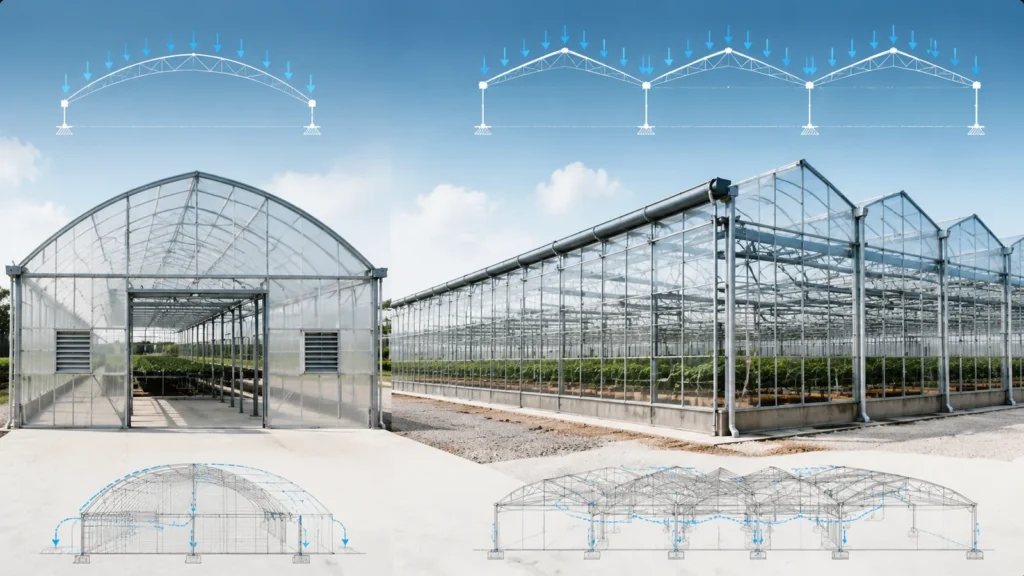
A single span greenhouse is an independent greenhouse structure with its own roof system, sidewalls, end walls, foundations or anchoring system, ventilation arrangement, and structural load path.
A multi span greenhouse connects multiple greenhouse bays into one continuous structure through repeated columns, roof sections, and commonly shared gutter lines.
Single-span greenhouses are often suitable for smaller projects, separated growing zones, irregular sites, or phased investment plans.
Multi-span greenhouses are commonly selected for medium and large commercial projects requiring continuous growing areas, efficient land utilization, centralized operations, mechanization, or integrated greenhouse systems.
However:
Multi-span is not automatically stronger, cheaper, or better for every project.
The correct selection depends on project conditions, including site layout, wind loads, snow loads, crop requirements, ventilation strategy, equipment integration, expansion plans, and local design requirements.
Single-Span vs Multi-Span Greenhouse: Quick Comparison
| Project Factor | Single-Span Greenhouse | Multi-Span Greenhouse |
|---|---|---|
| Structural layout | Independent greenhouse unit | Connected structural bays |
| Growing area | Separate production zones | Continuous growing area |
| Land utilization | Requires spacing between units | Higher continuous site coverage |
| Gutter system | Independent drainage arrangement | Shared gutter lines between spans |
| Structural grid | Independent frame layout | Repeated coordinated column grid |
| Expansion | Add additional independent houses | Extend through additional structural bays |
| Wind and snow review | Individual structure assessment | Connected system assessment |
| Ventilation | Simple unit-level planning | Integrated ventilation strategy |
| Equipment integration | Independent systems possible | Suitable for centralized systems |
| Installation | Simpler individual installation | Requires greater coordination |
| BOM | Smaller individual BOM | Larger but highly repetitive BOM |
| Commercial scale | Small or phased projects | Medium and large projects |
This comparison provides a general direction. Final greenhouse selection should always be based on project-specific engineering review.
What Is the Structural Difference Between Single-Span and Multi-Span Greenhouses?
The main difference is not simply the number of roof sections.
The key difference is how the structural system is organized.
Single-Span Greenhouse: Independent Structural Unit
A single-span greenhouse, also known as a freestanding greenhouse, works as an independent structure.
Typical characteristics include:
- Independent roof structure
- Independent sidewalls and end walls
- Separate foundation or anchoring system
- Individual ventilation arrangement
- Independent structural load path
If several single-span greenhouses are installed next to each other, each greenhouse remains an individual production unit.
This independence can be valuable when a project requires:
- Different crop environments
- Separate climate zones
- Phased investment
- Flexible site arrangement
- Independent production management
For smaller or irregular sites, this flexibility can become an important advantage.
Multi-Span Greenhouse: Connected Structural Bays
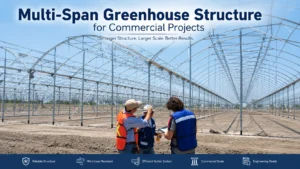
A multi-span greenhouse structure connects multiple greenhouse bays into one larger commercial structure.
The detailed multi-span greenhouse design considerations should be evaluated together with span arrangement, gutter height, wind conditions, and project requirements.
Depending on the design, adjacent spans may share:
- Structural columns
- Gutter systems
- Roof connections
- Drainage systems
- Internal circulation space
- Ventilation planning
The result is a continuous growing environment instead of several independent greenhouse houses.
This configuration is commonly used for commercial projects because it can support:
- Large-scale cultivation
- Centralized irrigation
- Mechanized operations
- Integrated environmental control
- Efficient internal logistics
For detailed multi-span engineering considerations, refer to:
Does Project Size Alone Determine the Choice?
No.
A small project is not always suitable for single-span, and a large project is not automatically suitable for multi-span.
Greenhouse selection depends on multiple factors:
- Site geometry
- Crop requirements
- Production strategy
- Wind conditions
- Snow conditions
- Greenhouse height
- Span width
- Covering material
- Ventilation requirements
- Automation level
- Future expansion plans
- Local construction requirements
For example, a 2,000 m² greenhouse on an irregular site may benefit from independent structures, while a larger commercial project may require a continuous multi-span layout.
The correct question is not:
“Which greenhouse type is bigger?”
The better question is:
“Which structural configuration fits the project requirements?”
How Do Single-Span and Multi-Span Greenhouses Differ in Land Utilization?
Land efficiency is one of the most important differences between the two structures.
Multiple single-span greenhouses usually require spacing between units for:
- Access routes
- Maintenance
- Drainage
- Construction clearance
- Utility connections
- Ventilation requirements
These spaces can reduce the percentage of land used for continuous growing.
A multi-span greenhouse connects adjacent bays and creates a larger uninterrupted production area.
This can support:
- Longer crop rows
- Centralized transportation
- Automated production systems
- Integrated irrigation
- Better internal workflow
However, site conditions remain important.
On irregular land or projects requiring independent production zones, single-span structures may provide greater flexibility.
How Do Gutters and Drainage Affect the Decision?
Gutter design is one of the major differences between single-span and multi-span greenhouse structures.
In multi-span systems, gutters between spans may:
- Collect roof runoff
- Connect adjacent roof sections
- Define drainage routes
- Influence greenhouse height
- Affect ventilation and covering details
As greenhouse size increases, drainage planning becomes increasingly important.
Factors that should be reviewed include:
- Rainfall intensity
- Greenhouse length
- Roof catchment area
- Gutter capacity
- Outlet arrangement
- Site drainage conditions
Single-span greenhouses generally have simpler individual drainage systems because they do not rely on shared internal gutters.
However, large developments with many separate greenhouse houses may create repeated drainage requirements.
Is a Multi-Span Greenhouse Stronger Than a Single-Span Greenhouse?
Not automatically.
This is one of the most important points in commercial greenhouse structure selection.
The terms single-span and multi-span describe structural configurations. They do not directly define structural strength.
Actual performance depends on:
- Design wind speed
- Snow load
- Wind direction
- Terrain exposure
- Roof geometry
- Span width
- Gutter height
- Column spacing
- Structural members
- Bracing system
- Connections
- Covering material
- Foundations
- Applicable design standards
Research on greenhouse structures has shown that wind pressure distribution can change depending on greenhouse geometry, roof configuration, and environmental conditions.
Therefore:
A multi-span greenhouse is not automatically stronger simply because multiple spans are connected.
The structural solution must be evaluated according to the actual project conditions.
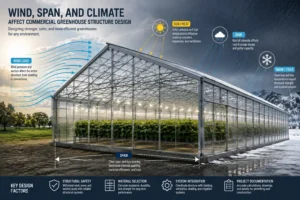
How Do Wind Loads Affect Single-Span and Multi-Span Greenhouses?
Wind is one of the most important environmental loads for greenhouse structures.
For commercial greenhouse projects, wind and snow loads should be evaluated during structural planning because greenhouse configuration, roof geometry, and local climate conditions can affect structural performance.
For single-span greenhouses, wind interacts mainly with an independent structural envelope.
For multi-span greenhouses, airflow interacts with multiple connected roof sections.
Different areas may experience different pressure conditions, including:
- Windward walls
- Roof edges
- First spans
- Intermediate spans
- Gutter zones
- Leeward areas
Wind performance depends on:
- Greenhouse orientation
- Roof shape
- Span arrangement
- Wind direction
- Site exposure
- Structural design
For commercial projects, greenhouse selection and wind-load evaluation should be considered together.
How Do Snow Loads Affect the Choice?
Snow loading is another important factor for commercial greenhouse projects.
The effect of snow depends on:
- Local snow conditions
- Roof geometry
- Roof slope
- Span width
- Structural spacing
- Covering material
- Greenhouse temperature conditions
- Uneven snow accumulation
Neither single-span nor multi-span automatically provides better snow performance.
The correct approach is to evaluate the proposed structural system according to the actual snow conditions at the project location.
How Do Ventilation Requirements Differ?
Ventilation is closely connected with greenhouse structure design.
Single-Span Ventilation
Single-span greenhouses can provide simple ventilation solutions through:
- Side ventilation
- Roof ventilation
- End ventilation
Because each greenhouse is independent, external walls are available around each unit.
Multi-Span Ventilation
Multi-span greenhouses require more integrated planning because the internal growing area becomes larger.
Important factors include:
- Roof vent design
- Greenhouse width
- Gutter height
- Wind conditions
- Crop density
- Cooling strategy
Modern commercial greenhouse projects should evaluate structure and environmental control systems together.
Which Structure Is Easier to Expand?
Both structures can support future expansion, but the expansion method is different.
Single-Span Expansion
Expansion usually means adding another independent greenhouse.
Advantages:
- Flexible investment phases
- Independent production zones
- Easier adaptation to irregular sites
Possible disadvantages:
- Repeated sidewalls
- Additional foundations
- Repeated ventilation systems
- More separate utility connections
Multi-Span Expansion
Multi-span projects can often expand by adding additional structural bays.
However, future expansion should be considered during initial design.
Important factors include:
- Foundation layout
- Gutter extension
- Drainage capacity
- Ventilation capacity
- Structural grid
- Utility planning
Future expansion is not only adding more greenhouse area. It requires engineering coordination.
Which Greenhouse Structure Has Lower Cost?
There is no universal answer.
Single-span greenhouses may have lower initial complexity for smaller projects.
However, multiple independent houses may require repeated:
- Sidewalls
- End walls
- Foundations
- Access spaces
- Utilities
- Drainage systems
Multi-span greenhouses may require more initial engineering coordination but can provide advantages at commercial scale through:
- Continuous production space
- Centralized systems
- Better land utilization
- Repeated structural modules
A better commercial comparison is:
Cost per usable growing area
rather than only:
Initial greenhouse purchase price
Project cost depends on:
- Greenhouse size
- Steel weight
- Design loads
- Covering system
- Ventilation
- Foundations
- Gutters
- Accessories
- Packing
- Shipping
- Installation requirements
What Can Go Wrong If the Wrong Greenhouse Configuration Is Selected?
Choosing a greenhouse type before understanding the project requirements can create problems.
Possible issues include:
Poor Land Utilization
The structure may not match the actual site layout.
Ventilation Problems
The selected configuration may not support the required climate-control strategy.
Drainage Conflicts
Gutter and drainage requirements may become difficult to modify later.
Equipment Installation Problems
Shading, irrigation, sensors, and automation systems may conflict with structural members.
Expansion Limitations
Future extensions may require changes to foundations, gutters, utilities, or ventilation.
More Field Modification
Poor coordination can increase cutting, drilling, welding, and installation adjustments.
A low initial quotation does not always represent the lowest project risk.
What Changes in the RFQ for Single-Span and Multi-Span Projects?
A commercial greenhouse quotation requires more information than only total area.
Single-Span Project Information
Typical inputs include:
- Number of greenhouse units
- Width and length
- Height requirements
- Covering material
- Ventilation method
- Foundation conditions
- Site location
Multi-Span Project Information
Additional inputs may include:
- Number of spans
- Span width
- Total length
- Gutter height
- Drainage arrangement
- Roof ventilation
- Equipment loads
- Expansion direction
- Local wind and snow conditions
For a professional quotation, complete greenhouse quotation information should be defined before structural configuration is finalized.
When Should You Choose a Single-Span Greenhouse?
A single-span greenhouse may be suitable when the project requires:
- Independent production areas
- Irregular land arrangement
- Smaller investment phases
- Separate crop environments
- Simple individual management
Choose single-span when flexibility and independence are more important than creating one continuous growing environment.
When Should You Choose a Multi-Span Greenhouse?
A multi-span greenhouse may be suitable when the project requires:
- Large continuous growing areas
- Higher land utilization
- Centralized operations
- Mechanized cultivation
- Integrated greenhouse systems
- Commercial-scale expansion
Choose multi-span when the project benefits from a coordinated production environment.
Commercial Project Selection Matrix
| Project Requirement | Single-Span | Multi-Span |
|---|---|---|
| Irregular site | ✓ | △ |
| Independent crop zones | ✓ | △ |
| Phased investment | ✓ | ✓ |
| Large continuous production | △ | ✓ |
| Centralized systems | △ | ✓ |
| Mechanized operation | △ | ✓ |
| Commercial EPC project | △ | ✓ |
| Future integrated expansion | ✓ | ✓ |
| High wind area | Engineering review | Engineering review |
| Snow region | Engineering review | Engineering review |
Frequently Asked Questions
Is a multi-span greenhouse always better?
No. The best choice depends on project requirements, climate conditions, production goals, and system integration needs.
Is a multi-span greenhouse stronger than a single-span greenhouse?
Not automatically. Structural strength depends on engineering design, materials, loads, connections, and foundations.
Which greenhouse costs less?
The answer depends on project scale. The better comparison is total project cost versus usable growing area and operational requirements.
Which greenhouse is easier to expand?
Both can expand. Single-span expands through independent units, while multi-span expands through additional structural bays.
Does a multi-span greenhouse require gutters?
Most conventional multi-span systems use gutters between connected spans, but the design depends on greenhouse configuration and drainage requirements.
Final Decision: Choose the Structure That Fits the Project
The difference between single-span and multi-span greenhouses is ultimately a difference in project architecture.
Single-span greenhouses provide independent structures and flexibility for smaller, separated, or phased developments.
Multi-span greenhouses create continuous commercial growing environments that support efficient land use, centralized operations, and integrated systems.
However, neither structure is automatically:
- cheaper
- stronger
- easier to ventilate
- better for every climate
The correct decision process is:
Project conditions → Structural requirements → Greenhouse configuration → System integration → BOM and quotation
Not:
Choose a greenhouse type first and force the project to fit it later.
For EPC contractors, greenhouse integrators, and commercial growers evaluating greenhouse structures, CHIYANG GREENHOUSE supports project-based structural configuration review, fabrication, export packing, and installation documentation.
The goal is not simply to supply greenhouse structures.
It is to make sure the structure fits the project.